
How does the temperature and cooling time of the mold affect the size and the length? Music
Release time:2026-09-20
Sets the temperature and cooling from four angles of crystal, surface reproduction, cooling balance and demoxification. This paper gives recommendations for actionable abbreviators in terms of material properties, temperature, speed, pressure, cooling and common defects.
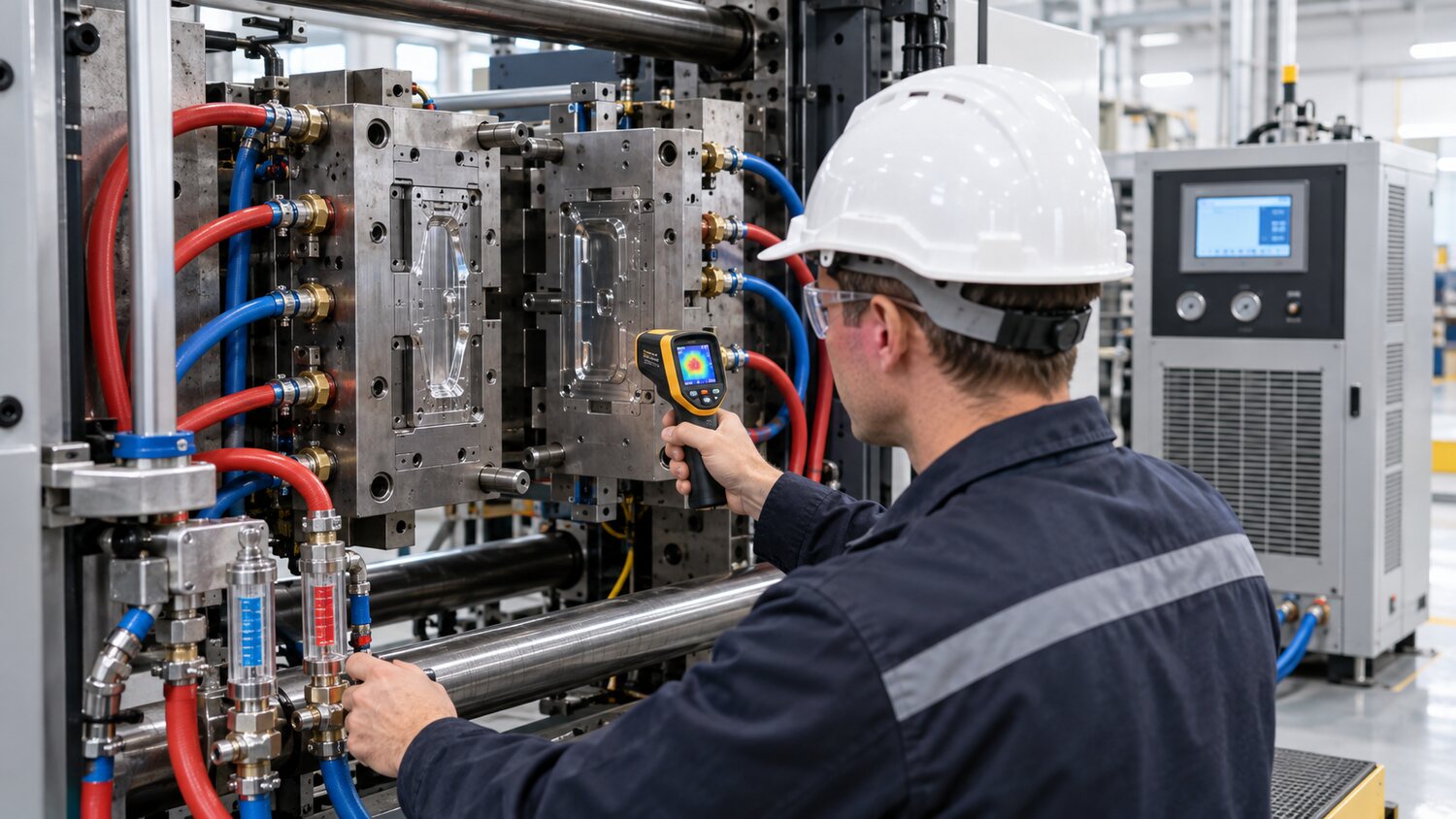
The temperature of the mold not only determines when the product can be demodeled, but also affects surface lightness, melting lines, crystals, condensation rates and residual stress. When the molluscs are too low, the front line of the melting is frozen quickly, thin walls and long ends are difficult to replicate, and are prone to flow marks, dumb light, visible melting wires or internal stress; too high temperatures can improve surface and melting strength, but can prolong cooling times and may increase the subsequent contraction of crystallized materials. Moderation should be based on the requirements of the resin type, product wall thickness, appearance and size, rather than reducing cooling water temperature in order to shorten the cycle.
Whether cooling is even or not is often more important than average temperature. Animation and aluminum, core and cavity, close to the watering mouth and at the end of the flow, when there is a clear temperature difference, and the product is constricted on both sides of the product, can result in bending, reversal and local dimming. The inspection should confirm the direction, flow, pressure differential and slurry of the water route and record the actual temperature of the water entering and leaving, rather than relying solely on the temperature control set. For deep cavities, long cores and thick wall bands, independent waterways, water insulations, fountains or high-conducted thermal coatings may be considered to allow for the timely removal of heat from local hot spots.
When the cooling time is fixed, the time can be gradually reduced and the immediate deformation, post-placement dimensions, pinmarks and viscos can be observed after the top is out. The fact that the product is just removed does not mean that cooling is sufficient, especially for semi-crystal materials and thick wall parts, which may still be hot inside, continue to contract or be deformed by mechanical handbands after modeling. For key size products, a pre-measure wetting or static time should be specified and a 24-hour change in size should be compared with different cooling conditions. When size fluctuations arise from water temperatures or changes in flow, increased pressure is usually uncurable.
Model temperature programmes also need to be aligned with injection speed and pressure protection. The increased temperature may extend the watering-off period, requiring a revalidation of the pressure time; the reduced temperature may lead to an increase in pressure at the original switching point and speed. The cooling water temperature, surface temperature and cyclical stability of the moulds should be monitored during continuous production. If an area is unable to control a warp for a long period of time by supercooling, the product wall thickness, mouth location, fibre orientation and water route design should be reviewed. If necessary, it is also necessary to confirm that the sculptivation of the screws is even, as the melting temperature will also translate into cooling contractions in different regions.