
What's the choice of a snail for the instrument? Cutting and compression points
Release time:2025-08-07
How do you choose the cut-and-compression point of the instrument's casings? First, the plastic plate number and filling ratio are identified, then the plastics specifications, product sizes and mass defects are checked, and the long-range ratio, compression ratio, mixing structures and screw material is finalized. This paper combines information on star-friend screw stations to organize selection, process and validation elements.
The core conclusion of the instrument's shell is that
First, the plastic plate number and filling ratio are identified, then the plastics specifications, product sizes and mass defects are checked, and the long-range ratio, compression ratio, mixing structures and screw material is finalized.
The key to the quality of the instrument ' s shell formation: a plume-heavy scheme with moderate cutting and reasonable compression
In the field of industrial instrumentation, the shell (e.g., the industrial control cabinet, the control panel) not only serves as a protective structure for the equipment but also ensures the stability of display and operation. These products must meet the requirements of tensile strength 60 MPa, a warp ≤ 0.2 mm/m (to ensure that the installation is closely aligned), and a surface free of ripples (coarse ≤ 0.1 m). At present, instruments and cysts that produce materials such as ABS, PC etc. with general equipment tend to have a success rate of less than 75 per cent, of which 25 per cent are waste due to insufficient intensity, 20 per cent are warp defects and 15 per cent are surface ripples. The present paper analyses the process properties of commonly used instrument instrument shell materials in the context of specific data, focusing on how they can improve product quality and production efficiency in the production process. Special plating screws, cut to the right, compression is more than reasonable to achieve high-quality formation, and target production pains.
Core mass pain points and technology needs for instrument shell production
Quality defects in instrument instrumentation shell are closely related to material flow characteristics, stress distribution, etc. In terms of industry standards, the plane size of the working control panel requires ≤0.1 mm/m, otherwise it is easy to cause Key Cardon; the surface-lined depth of the shell requires ≤0.05 mm, so that the impact does not show clarity; and in the -40°C to 80°C environmental tests, the impact strength maintenance rate is 85%.
The mechanisms behind these pain spots are focused on three main areas: first, the problem of strength. ABS materials can break through the molecular chain with overcuting, leading to a 20 per cent reduction in impact intensity (from 25 kJ/m2 to 20 kJ/m2); and second, warp problem. In the process of cooling, the PC melt produces internal stress, resulting in a warp exceeding 0.3 mm/m, if the temperature gradient exceeds 5 °C/cm; and, third, surface ripple problems. Melting pressure fluctuations of more than 8 per cent of the normal plume screws destabilize the front line of movement and create cyclical ripples.
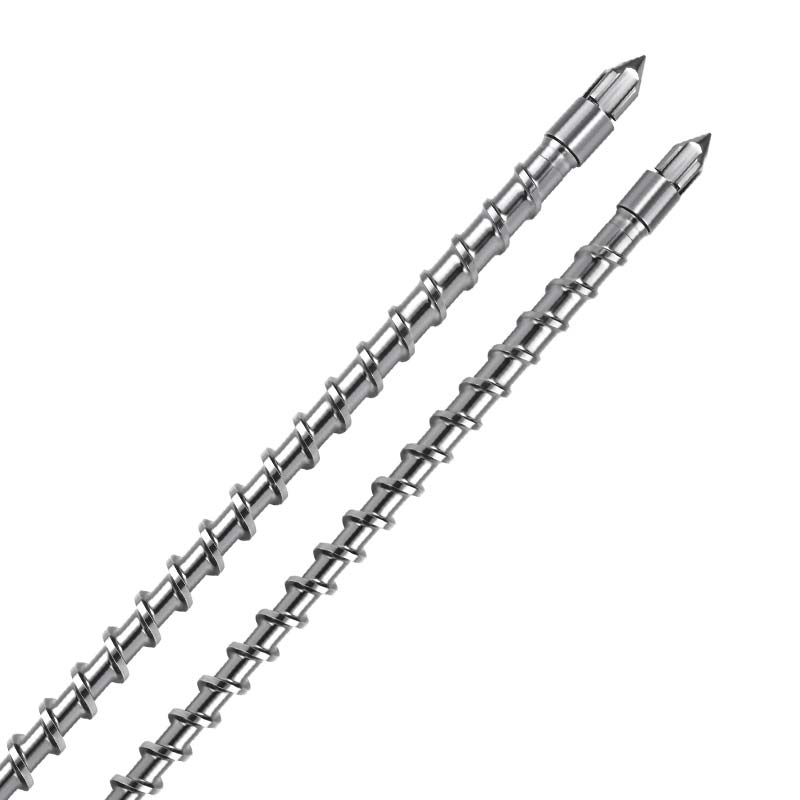
The technical advantage of a moderate cut, a reasonable compression, compared to a plastic screw.
In response to the difficulty of processing the instrument's shell, the special plywood screws are cut to the point where the compression has reasonably optimized the structure:
Moderate cut controls to ensure strength and surface quality
The screw measurement segment is designed with a corrosive length (sickness smoothing from 55 mm to 45 mm), which stabilizes the cut-off rate at 120-160s-1 (normal screws 180-250s-1), with fluctuations within > 5%. The test data indicate that the impact intensity increased from 20 kJ/m2 to 26kJ/m2 when the design processed the ABS shell, and the under-intensity rate decreased from 25 per cent to 4.2 per cent for waste products; while the surface ripple incidence dropped from 15 per cent to 2.1 per cent for PC materials, the Ra value decreased from 0.15 to 0.08 per cent, fully meeting the surface requirements of the display panel.
Reasonable compression compared to design to reduce warp and stress
The propeller uses a compression ratio of 2.8-3.2 (or 3.5-4.0 in the normal screw) and a compression segment length of 25 per cent of the total length of the screw, ensuring the stability of the pressure gradient (0.0.5 MPa/mm) when the molten form. Production data show that the arcity of the PC shell decreased from 0.35 mm/m to 0.18 mm/m, with an increase in the eligibility rate from 80 to 98 per cent; and by reducing the internal stress of the molten body, the rate of shock strength in high-temperature environmental trials increased from 80 to 92 per cent.
Balanced flow design, optimized cavity fill
A cone-shaped buffer structure is used in the head of the screws, which is accompanied by a gradient to halt the loops and to keep pressure fluctuations in the molten entering cavity within > 3 per cent (the normal screw is > 8 per cent). The control panel produced by multiple cavity molds was tested to reduce the weight deviation per cavity filling from ±4 per cent to ±1.2 per cent and the cavity filling balance from 82 per cent to 99 per cent, effectively avoiding local intensities due to uneven filling.
Validation of effects in practical application
Production data from an instrument manufacturer show that the rate of acceptance of the shell using a cut-in-the-mixer, which compresses more than a reasonable ABS, increased from 72 per cent to 98.5 per cent. Specifically, the intensity of the under-intensity of waste fell from 25 per cent to 2.3 per cent, the warp rate from 20 per cent to 1.5 per cent, and the surface ripple rate from 15 per cent to 1.1 per cent; the PC control panel level was stabilized at 0.08 mm/m, and the success rate for the high-temperature cryogenic test increased from 85 per cent to 99 per cent.
In terms of cost-effectiveness, the use of materials increased from 80 to 96 per cent, resulting in annual savings of approximately $3.8 million in raw materials, based on the production of 5 million instrument casings per year; production efficiency increased by 30 per cent and combined production costs decreased by 20 per cent as a result of the reduction in polishing and back-to-work processes.
This cut-in-the-cut, compressed, and reasonably-compressed plywood screw, by precisely controlling the shearing and pressure, provides a perfect balance between the strength, flatness and surface mass of the instrument's shell. As industrial instruments move in the direction of miniaturization and high precision, the screw will become the core equipment for the production of high-quality shells, driving the industry towards “zero defects”.
Data to be recorded before implementation
- Material integrity number, filling ratio, flame-retarding system, refill ratio and dry condition.
- Note plastics brand, model, screw diameter, voltage, back pressure, turn speed and current screw structure.
- Indicators of product size, wall thickness, appearance or strength, and current adverse phenomena and frequency of occurrence.
- Continuous production cycle, refuelling frequency, machine clean-up method, wear and tear record and planned useful life.
How to validate the adjustment results
It is recommended that the current process baseline be established, followed by a single-variant test model. Each round records the measurement of time, melting temperature, product weight, formation cycle and bad rate, avoiding multiple parameters being changed at the same time to determine the cause. The parameters in the text are used to illustrate design thinking and should not replace material supplier data and on-site safety protocols.
What kind of support is a star-friend screw?
The Starfleet Mechanical Equipment Co. Ltd. (Starfeng) provides materials and situational assessments, screw structural recommendations, base and surface treatment options, non-spect size customization, and a reset of test problems around instrument casings. The submission of information on raw materials, equipment and products could lead to more targeted programmes.
Ask for customized screws immediately, or check firstNote plastic screw productwithNote Plastic SolutionsI don't know.