
PMMA Yaccult Characteristics and High Translucency Ploting
Release time:2026-09-20
From clean drying, molten cut, model reproduction and internal stress control, to improve PMMA transparency product performance. This paper gives recommendations for actionable abbreviators in terms of material properties, temperature, speed, pressure, cooling and common defects.
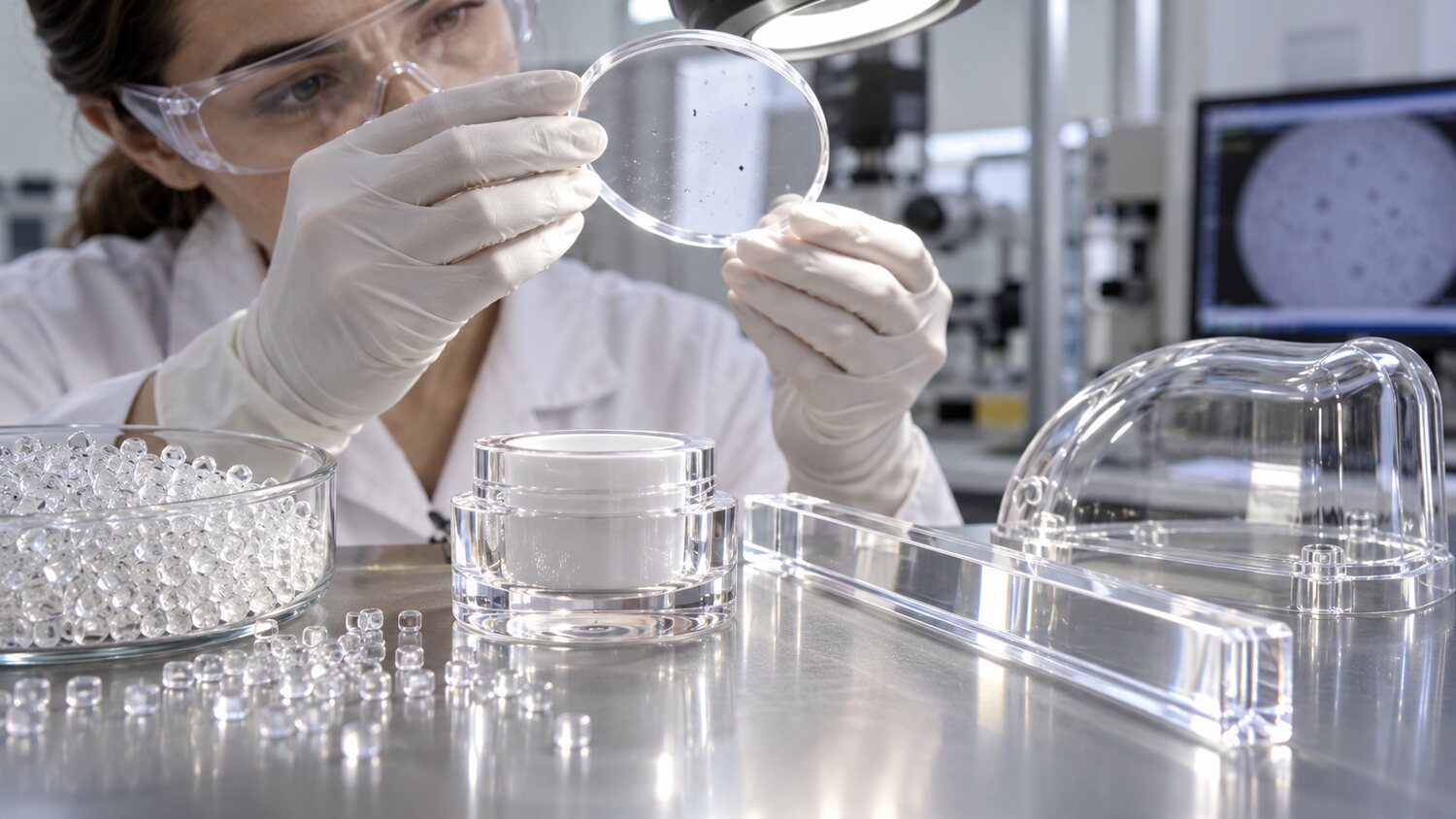
PMMA has a high perforation rate, good tolerance and a high surface hardness, which is often used for lenses, guidees, instrument panels, lamps and cosmetic packaging. It is more sensitive to water, pollution, cut-off and residual stress and is magnified by small black spots, silver threads and fluids in transparent products. The production shall be preceded by full drying in accordance with a specific plate number and cleaning of the cascading, pipelines, magnets and drums. Recoverers must be sourced in a clear, dust-free and heat-degrading manner, and transparency requires that products usually be more restrictive in their proportion.
PMMA is more adhesive and requires sufficient melting and morbid temperature to fill, but too high or too long can change yellow, rise bubbles and produce black dots. The rotation and back pressure of the screws shall be based on uniform plasticization to avoid overcuting. Injection speeds are set in fractions: no spray and high shears are used when watering, steady movement is maintained on the main transparency level, and when approaching the end, the speed is appropriately reduced and full exhaust is used. In the event of a very high-speed force-through of a small sip, the fog, stress marks or cracks are often formed near the sip.
Steam surfaces, watering and venting have a significant impact on optical appearances. An increase in the temperature of the molluscs helps to replicate the polished face, mitigate the melting line and surface flow marks, but a lack of cooling can deform or glue the product. The pressure should be gradually validated with the objective of eliminating water contraction and maintaining size, and excessive pressure increases internal stress. For components requiring silk prints, sprays, ultrasonic welding or metal assembly, the test stress shall be broken under post-process conditions. Where necessary, internal stress should be judged using photometric observation or repulsion tests, and not only transparency at the time of emergence.
The production of transparent materials requires a high level of cleanliness of screws and drums. Fluid horns, screws, anti-reversible circulatory materials and nozzles of carbon will continue to bring out black spots. When changing colours or switching from dark to transparent materials, the compatible clean-up process should be used and the uncleaning of hard-to-cleansed areas should be used, and the mere long-duration ejection may increase material heat history. The screw structure needs to be balanced with temperature and melting and stabilization measures to avoid local high cutting. The final process shall provide for clean operations, drying, maximum stop time and visual testing of light sources, so that transparency, size and post-processing reliability are consistent.