
How to train a sales team to identify standards and a dedicated screw.
Release time:2026-09-22
(c) For manufacturers of retrofit machines, a method of checking materials, typical defects, key parameters and upgraded values, an analysis of the risk that technical opportunities will not be detected if the sale is priced only, and a recommendation for validation of the training judgement and the conversion rate of the technology trail and programme using case cards and demand questionnaires.
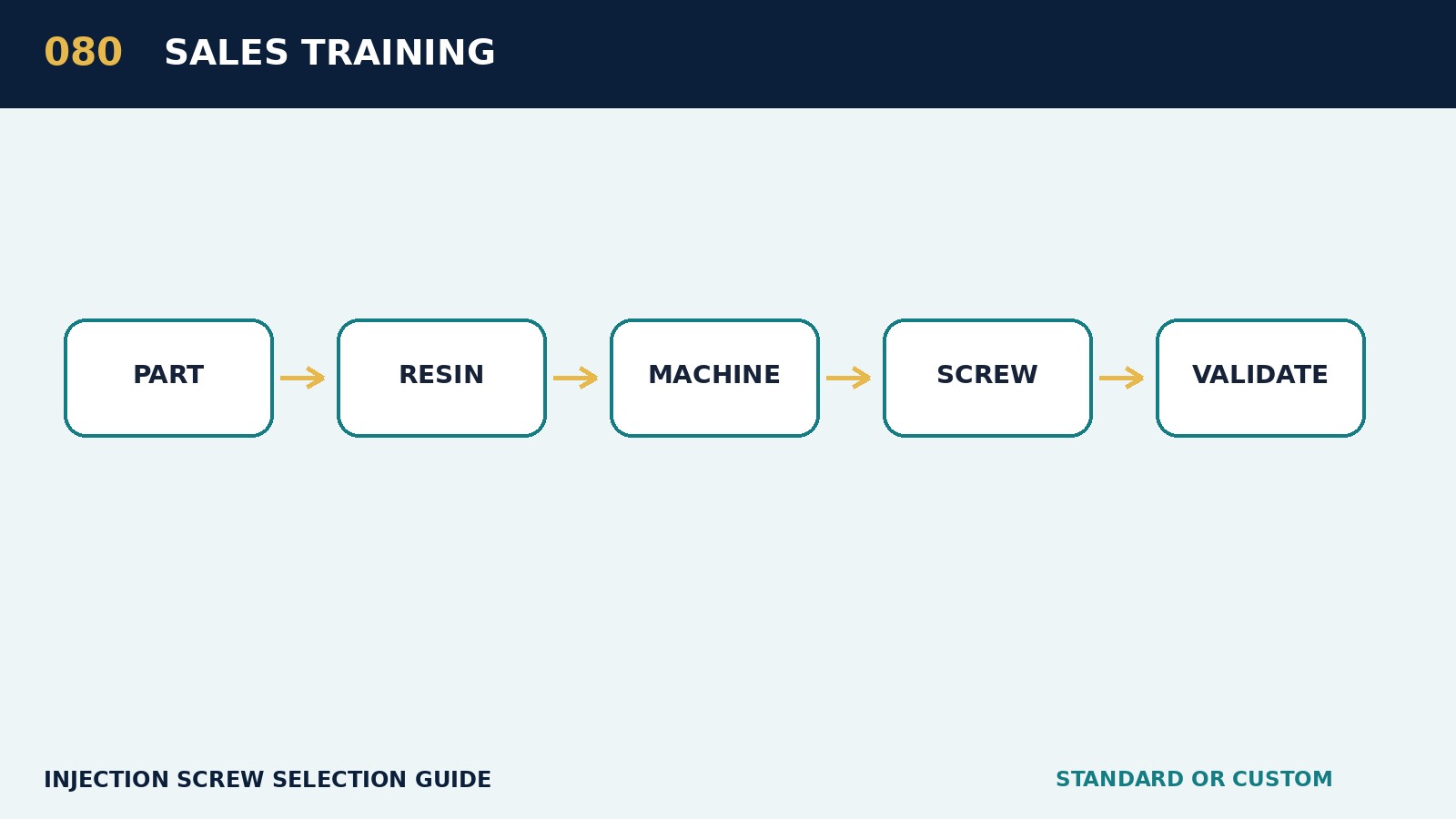
The problem with many sales training projects is not the lack of equipment capacity, but the omission of the material community, typical deficiencies, key parameters and the value of the upgrade at the selection stage. A technical confirmation by the manufacturer of a note machine would significantly reduce the risk of subsequent re-engineering and complaints if it were completed by the manufacturer ' s manager prior to the offer.
The value of technology sales is to reduce the risk that customers will miss the equipment and accessories. Sales personnel need to close the demand questionnaire, technical evaluation, quotation boundaries, delivery nodes and post-sale recording, so that customers know what data each recommendation is based on, and that internal design and manufacturing teams have consistent information. It is recommended that customer information be broken down into five groups: products and moulds, raw materials, platforms, process objectives and existing problems. Product end logs of single weight, flowway, number of caves, wall thickness and appearance levels; ratio of feedstock end recorder number, melting finger, filling, flame retardation and retrofitting; terminal logs of tonnage, voltage, screw diameter, maximum travel, injection pressure and plasticization. All data are sourced and are marked, drawn, physical, measured or estimated by clients.
Material analysis cannot remain under PPP, ABS or PA names. The specific plate number, the percentage of the product or mineral filling, the flame-retarding system, the water-bearing requirements, the permitted stay time and the recommended processing temperature should be checked. Differences in the sensitivity of viscosity, wear, corrosiveness and shearing may be apparent in the broad categories of the same material, which change the compression ratio, the three-part ratio, alloy and surface treatment. The focus of discussion in this paper is on the material community, typical defects, key parameters and upgraded values, which must correspond to the customer ' s current production conditions and cannot be used only for the maximum values in machine samples.
The implementable programmes are judged by case cards and needs questionnaires. The quoted documents should include both the applicable raw materials, the range of recommended voltage, the permitted turn-off and back pressure, the size of the interface, the material and thermal treatment, and the need for re-evaluation when marking subsequent changes to the material or the mould by the client. This would prevent the use of earmarked programmes in completely different conditions.
Special vigilance is needed to sell at a price that does not reveal technological opportunities. Many of the post-sale disputes arise from inconsistencies between the design input and the actual production conditions, such as the customer ' s replacement of the raw material number, the increase in the return rate or the transfer of the screw to another set of moulds, while still requiring the maintenance of the original acceptance results. The configuration of the boundary and change management should therefore be included in the technical document.
Upon completion of the project, the technical clue and programme conversion rates were used as delivery conclusions and the size tests, material or thermal treatment certificates, trial modelling records and maintenance recommendations were archived. Sales teams can return after three months or a ton agreement to compare plasticization time, energy consumption, product fluctuations and wear and tear trends. The sales proposal should answer three questions at the same time: why this selection was made, which conditions had changed and which were re-selected, and how the customer validated the results. By making these three issues clear, sales training can move from a trade in accessories to a traceability technology project.