
Why recheck the screws when the customer replaces the supplier?
Release time:2026-09-22
(b) For the sale and post-sales team of the Apostilles, describe the method of checking changes in melting fingers, fillings, flame retardation systems and water-bearing rates, analyse the risk that differences in currents and wear and tear in the same material range will be ignored, and provide a comparative table of old and new objects and recommendations for the validation of temperature, back pressure and screw structure and plastic fluctuations, black spots and periodic changes.
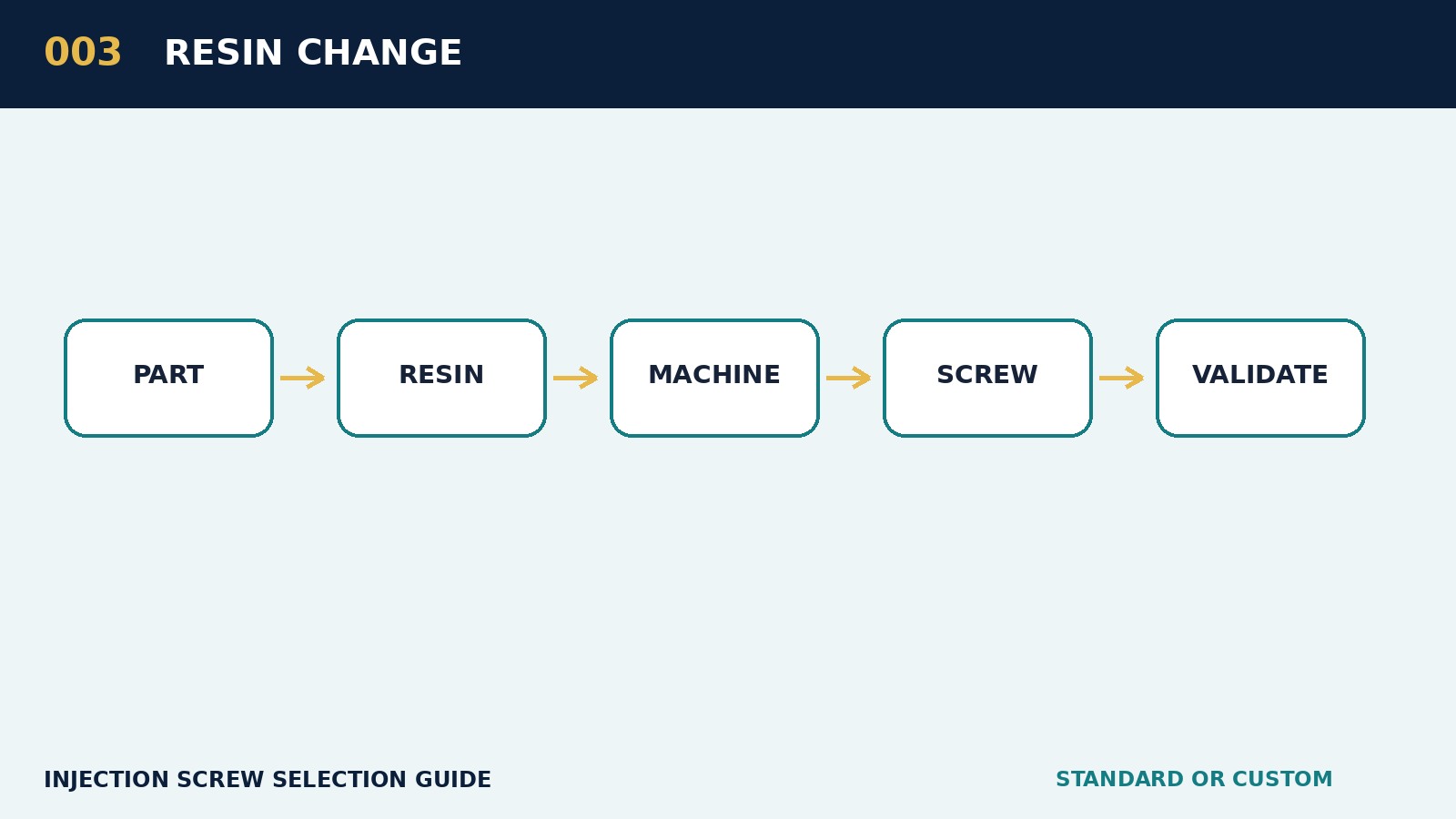
The switch from the feedstock supplier to what appears to be a conventional equipment selection is actually prone to deviations because changes in melting fingers, fillings, flame retardation systems and water content rates are not assessed at the same time. For the after-sale team, the right approach is to establish a baseline of the work and then discuss the specific configuration.
The core of the demand phase is not to immediately give a screw model, but to convert the client ' s product target into a calculable data. Product weights, project sizes, wall thickness, flow ratio, number of lacquers, flow weights, material plates and target cycles must be placed in the same record; if one of them has not been identified by the customer, it should be clearly marked as a hypothesis and the sales calibre should not be mistaken for final technical condition. It is recommended that customer information be broken down into five groups: products and moulds, raw materials, platforms, process objectives and existing problems. Product end logs of single weight, flowway, number of caves, wall thickness and appearance levels; ratio of feedstock end recorder number, melting finger, filling, flame retardation and retrofitting; terminal logs of tonnage, voltage, screw diameter, maximum travel, injection pressure and plasticization. All data are sourced and are marked, drawn, physical, measured or estimated by clients.
Material analysis cannot remain under PPP, ABS or PA names. The specific plate number, the percentage of the product or mineral filling, the flame-retarding system, the water-bearing requirements, the permitted stay time and the recommended processing temperature should be checked. Differences in the sensitivity of viscosity, wear, corrosiveness and shearing may be apparent in the broad categories of the same material, which change the compression ratio, the three-part ratio, alloy and surface treatment. The focus of discussion in this paper is on changes in melting fingers, fillings, flame retardation systems and water content rates, which must correspond to the customer ' s current production conditions and not be limited to the maximum values in machine samples.
In the context of this project, the idea of “comparisoning old and new material tables and reviewing temperature, back pressure and screw structure” is proposed. First, to determine whether the available data support the choice, then to calculate the volume of reductive, pressure and plasticization, and finally to discuss the geometry, front-end components and material handling of the screws. If the standard scheme is able to cover the window, priority should be given to the standard configuration; if the risk of differences between the flow and wear and tear in the same material category remains, a dedicated structure should be proposed and increased costs, delivery periods and expected benefits should be indicated.
The cost of the misconfiguration is not only the screw itself, but also the cut-off, the waste of raw materials, the testing of molds, the delay in delivery and the credibility of customers. Precautionary measures around differences in the flow and wear and tear of different brands of the same material have been ignored, more economical than repeated transfers after problems have arisen; the vendor can then move from a mere offerer to a partner capable of carrying out technical screening.
Upon completion of the project, the result of the delivery was plastic fluctuations, black dots and periodic changes, and the size tests, material or thermal treatment certificates, trial modelling records and maintenance recommendations were archived. Sales teams can return after three months or a ton agreement to compare plasticization time, energy consumption, product fluctuations and wear and tear trends. Where the information is temporarily incomplete, the pre-selection scope and the list to be confirmed may be provided, but it should not be considered a final commitment. The freeze of the configuration after the customer has completed the smelting finger, filling, flame retardation system and water-bearing rate changes can reduce the wrong order and facilitate the production, testing, installation and sale of the same version of data.