
Precision gear pump valves and transferer abbreviators
Release time:2026-09-20
Precision to POM PA and PBT, control the circle size shrink friction performance and long-term stability. This paper gives recommendations for actionable abbreviators in terms of material properties, temperature, speed, pressure, cooling and common defects.
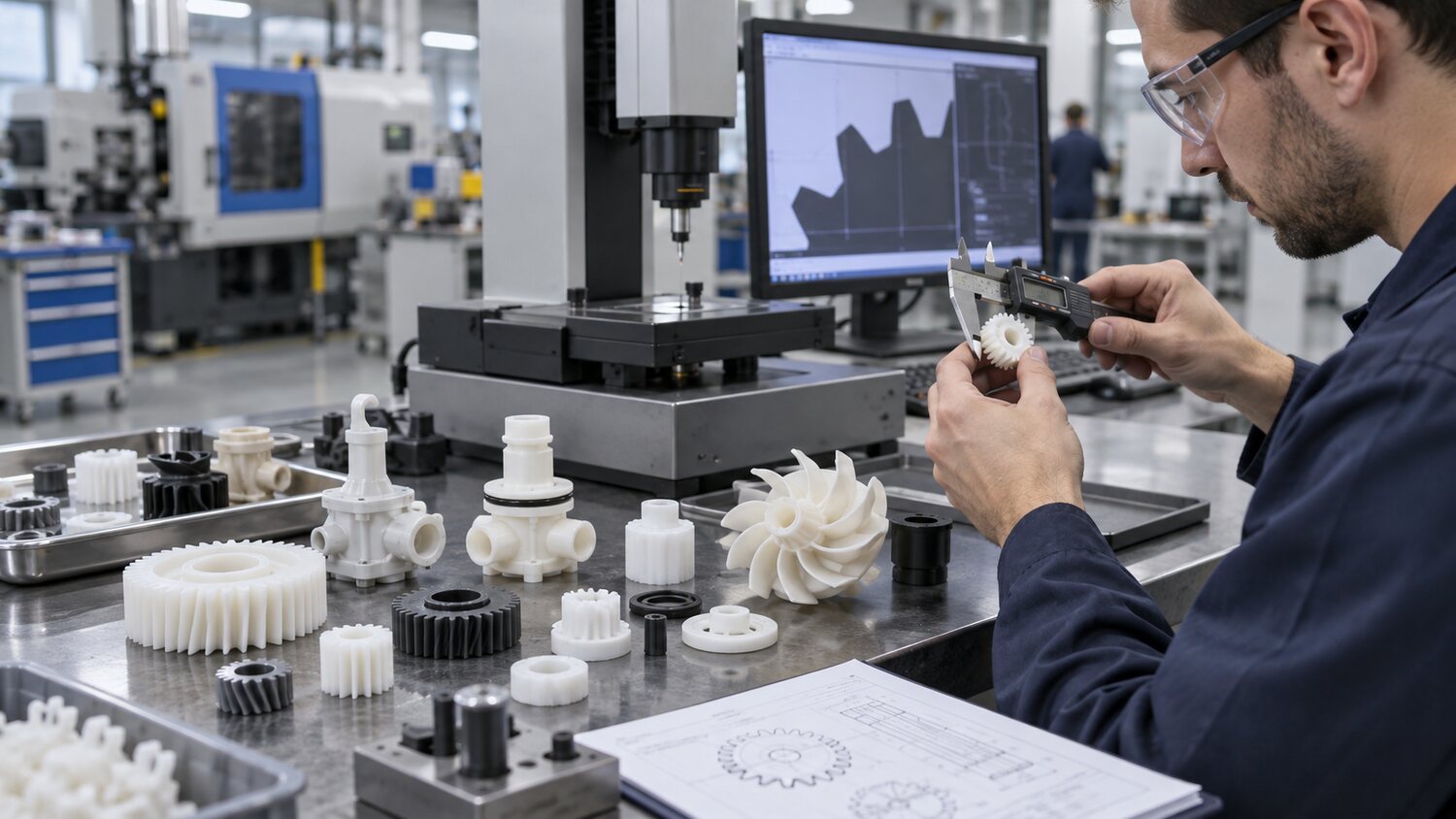
Precision gears, axles, pump valves and sliders often use POM, PA, PBT or enhanced modified materials. The size of the product is small, but it requires high apertures, circles, teeth, cones, frictions and fatigue. The switchboard shall be preceded by a specification of the wetting, crystallization, filling and wetting conditions of the material and a time for measurement. Wetting after the nylon model changes the size and resilience, and the crystallization and post-constriction of POM and polyesters also makes immediate measurements different from post-stabilization measurements and does not allow for a process of judging by a set of untimed dimensions.
The process establishment proposal starts with a stable weight. Short-shot identification of filling and switching points, determination of the watering-off time through the weight platform, and adjustment of the sub-pressure control thin zone contraction. Overpressure can lead to insufficiency of water, apertures and teeth, which can lead to difficulties, residual stress or large sizes. The size and location of the small sip should be assessed if it is too early to be closed and it is ineffective to continue to increase the pressure. Modular temperatures need to remain stable and even, avoiding varying degrees of crystallization on both sides of the tooth ring or in different areas of the valve.
Circles and arcs are often caused by uneven flow orientation, top-out and cooling. The direction of the botilizer booster material is more evident and the retrofitting programme is decisive. An imbalanced top pin, premature demodulation or mechanical hand-held can also distort thermal products. Rover noise, leak, twist or slide performance should be checked under actual assembly and load conditions, not just static dimensions. In the event of cyclical fluctuations in size, the weight of the product, the mat, the reversal ring and water temperature trends should be checked.
Precision elements require high repetition measures for screws. The gel is too small to use a large diameter spiral, which is easy to stay for too long and does not measure resolution; the reversal wears can cause a return flow, and the appearance may still be normal but the size is already drifting. In the case of steroids and mineral fillings, grinding screws and drums should be used and fibre damage caused by high back pressure should be controlled. Process confirmation should cover batches of materials, reboots of equipment and long-term continuous production, and establish a range of weight, pressure and critical dimensions to ensure a stable conductive and sealed performance.