
What are the special conditions to care about with the embedded embedding project configuration screw?
Release time:2026-09-22
(b) For stand-by machine manufacturers and distributors, describe the method of checking the temperature of the embedded, the location of the watering, the flow of materials and the short-cycle requirements, analyse the risk that neglect of the embedded inhaling and positioning rhythms will lead to unstable filling, and provide recommendations for the validation of the plastic units and the packaging integrity, metrology and melting line strength by the thermal load and form rhythm of the embedded parts.
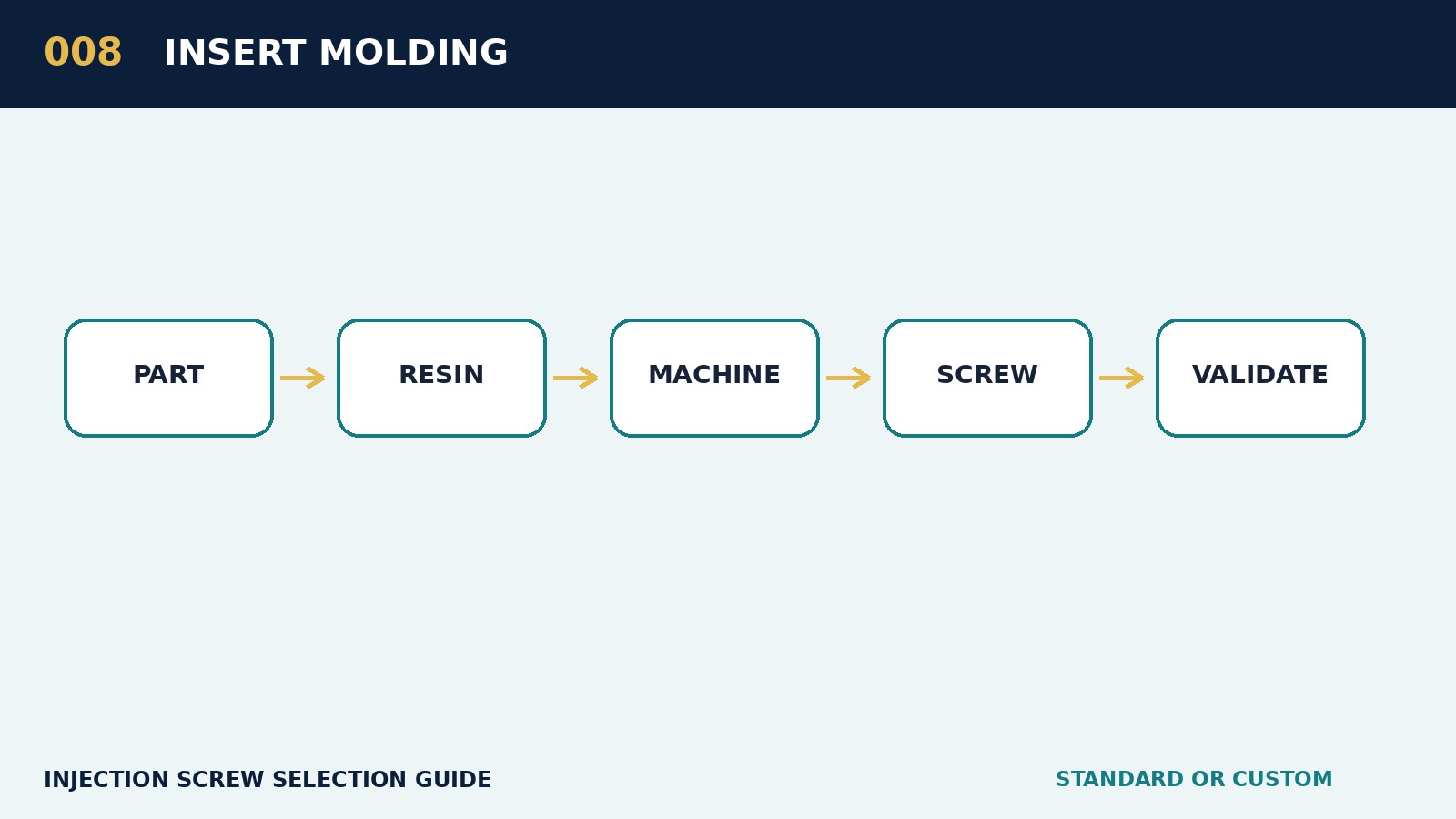
Embedded replicas appear to be a conventional device selection and are actually prone to deviations due to the temperature of the embedding, the location of the watering, material mobility and short-cycle requirements that are not assessed simultaneously. For stand-alone machines and distributors, the right approach would be to establish a baseline of conditions before discussing specific configurations.
The core of the demand phase is not to immediately give a screw model, but to convert the client ' s product target into a calculable data. Product weights, project sizes, wall thickness, flow ratio, number of lacquers, flow weights, material plates and target cycles must be placed in the same record; if one of them has not been identified by the customer, it should be clearly marked as a hypothesis and the sales calibre should not be mistaken for final technical condition. Site information should preferably include both photographs, short videos and data sheets. Photos are used to identify machine interfaces, screw tails and front-end components, video can be observed to measure, buffer and abnormal sound, and data tables are used to calculate the rate of application, the need for plasticization per hour and the length of stay. If only partial information can be obtained, a list should be provided for confirmation, rather than a tentative condition being a definitive conclusion.
Material analysis cannot remain under PPP, ABS or PA names. The specific plate number, the percentage of the product or mineral filling, the flame-retarding system, the water-bearing requirements, the permitted stay time and the recommended processing temperature should be checked. Differences in the sensitivity of viscosity, wear, corrosiveness and shearing may be apparent in the broad categories of the same material, which change the compression ratio, the three-part ratio, alloy and surface treatment. The focus of discussion in this paper is on the temperature of the embedded, the location of the watering, material mobility and short-term requirements, which must correspond to the customer ' s current production conditions and not be limited to the maximum values in the machine sample.
The implementable option is to configure the plasticization unit by thermal load and form pace of the embedded. The quoted documents should include both the applicable raw materials, the range of recommended voltage, the permitted turn-off and back pressure, the size of the interface, the material and thermal treatment, and the need for re-evaluation when marking subsequent changes to the material or the mould by the client. This would prevent the use of earmarked programmes in completely different conditions.
If the above-mentioned steps are ignored, the most common consequence is that neglect of the embedded heat and positioning rhythm leads to unstable filling. The problems are often manifested in the trial phase of measuring time instability, insufficient stress residuals, buffer drift, unmelted, black spots, colour differentials or increased wear and tear. Continued increase in temperature, back pressure and turn speed at this time may temporarily improve the appearance, but may increase the shearing heat, material degradation and equipment load.
At the time of acceptance, it is recommended that the main indicator be the completeness of the package, the nodal and the strength of the melting line, and that the temperature, screw velocity, back pressure, measurement position, buffer position, injection peak pressure and continuous sample weight be simultaneously recorded in the drums. At least three reasonable process points, low, medium and high, are covered to confirm that the programme is not effective under a single parameter. With the continuous accumulation of embedded project data, the equipment manufacturer can gradually establish a package, a trade package and an aircraft-type menu to allow sales to quickly identify general and special conditions, while at the same time placing a truly complex project in a timely manner for evaluation by an application engineer.