
PE Polyethylene Particle Characteristics and Apostilles Proposal
Release time:2026-09-20
Compare the movement of HDPE with the movement of LDPE, shrink and flex, and give a big, thin-walled, and sealed-out-product focus. This paper gives recommendations for actionable abbreviators in terms of material properties, temperature, speed, pressure, cooling and common defects.
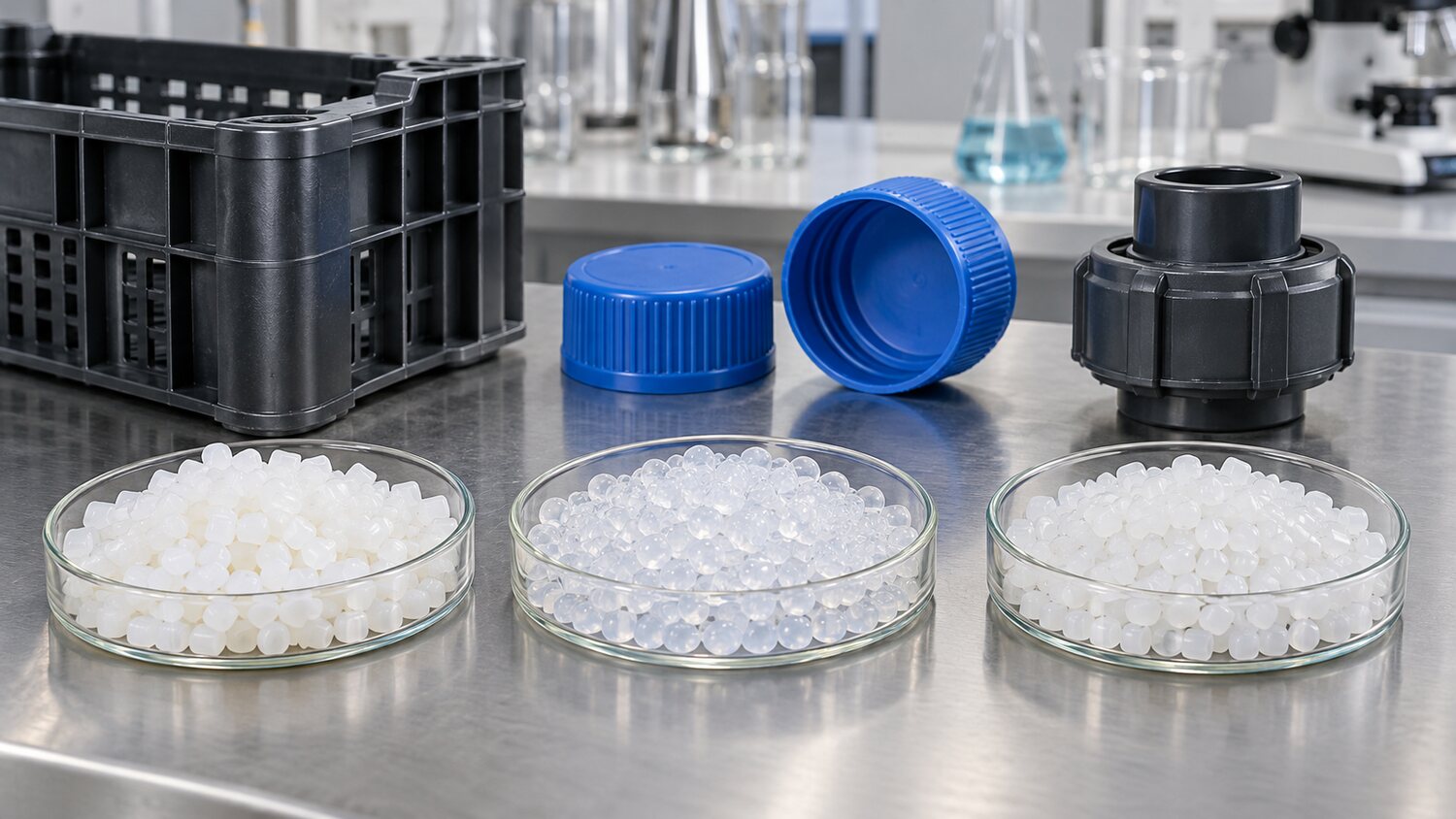
PE includes various types, including HDPE, LDPE, LLDPE, which are chemically resistant, low-temperature and low-inhalation, but vary in density, stratification, rigidity and melting strength. HDPE is often used in swingboxes, bottlecaps, tubes and industrial parts, which are more rigid and have significant crystal contractions; and LDPE and LLDPE are softer, often for soft caps, squeezed-type structures or components that require resilience. In order to confirm density, fusion rate, filling and product use, no uniform temperature can be set for “PE” alone. Remittance ratios and batch changes can also significantly affect contraction and shock performance.
The liquidity of the PE is generally good, but cooling contractions and demodeling deformations require focused control. The temperature of the drums should form a flat gradient, avoiding overheating near the heating vent leading to slippages, and preventing the nozzle from colding into cooling. Injecting speeds can be selected according to wall thickness, and medium-speed speeds can help fill long processes, but when entering the end of the flow, they need to be properly slowed to prevent accelerations and fractional sides. The back pressure, which is primarily to keep the melting even and measure stability, increases the shearing temperature and changes the product ' s contraction and size.
For large-sized boxes, pallets and containers, arcs are often derived from fluid orientation, water temperature differentials and local wall thickness, not only from inadequate pressure protection. It is important to check the balance of the sips, the consistency of the aerometric cooling, and to avoid the pressure of the exhausts through excessive locking. The thick-wall HDPE product requires sufficient preservatives, but if the water is closed, it will not be effective to continue to extend the pressure; water reduction should be addressed by the size, location and local cooling. If a soft PE product is white, bruised or glued, it is checked for demodetic slopes, modeling, cooling and peak balance.
PE particles are vulnerable to electrostatic and dust contamination of the feed, and the dispersion of the chromosomal mother may also vary with the ability of the screws to mix. High-scale regenerative PEs also lead to melting fingers, pollutants and odour fluctuations, and criteria for selection, filtration and mass homogeneity should be established. If the measurement is slow, the feeder bridge, screw slide and particle density can be checked. When processing high-filled or refuelling materials, the snails and drums are more resilient, aggregated elements and exhausts than simply increasing the temperature. The final process is to be confirmed by a product function test, such as size, fall, seal or load, and not only by whether the surface is full.