
How does the Cave Number Model project match plasticization and gel stability?
Release time:2026-09-22
For Apostille manufacturers, describe the method of checking the mass of the main stream, the number of caves, the cycle and the amount of material adhesive, analyse the risks of incomplete or evaporating the mass of the caves due to insufficient plasticization capacity, and give recommendations for the validation of the screws and the driving capacity per hour, and the cyclical attainment rates, which are very poor in the weight of the caves.
The problem with many high-density moulds is not the lack of equipment capacity, but the omission of the general flow weight, cave balance, cycle and material viscosity during the selection phase. Retrofitting and complaint risks can be significantly reduced if the manufacturer completes the technical confirmation prior to the offer.
The core of the demand phase is not to immediately give a screw model, but to convert the client ' s product target into a calculable data. Product weights, project sizes, wall thickness, flow ratio, number of lacquers, flow weights, material plates and target cycles must be placed in the same record; if one of them has not been identified by the customer, it should be clearly marked as a hypothesis and the sales calibre should not be mistaken for final technical condition. It is recommended that customer information be broken down into five groups: products and moulds, raw materials, platforms, process objectives and existing problems. Product end logs of single weight, flowway, number of caves, wall thickness and appearance levels; ratio of feedstock end recorder number, melting finger, filling, flame retardation and retrofitting; terminal logs of tonnage, voltage, screw diameter, maximum travel, injection pressure and plasticization. All data are sourced and are marked, drawn, physical, measured or estimated by clients.
Site information should preferably include both photographs, short videos and data sheets. Photos are used to identify machine interfaces, screw tails and front-end components, video can be observed to measure, buffer and abnormal sound, and data tables are used to calculate the rate of application, the need for plasticization per hour and the length of stay. If only partial information can be obtained, a list should be provided for confirmation, rather than a tentative condition being a definitive conclusion. The focus of the discussion here is the mass of the main stream, the balance of the den, the periodicity and the material viscosity, which must correspond to the customer ' s current production conditions and not be limited to the maximum values in machine samples.
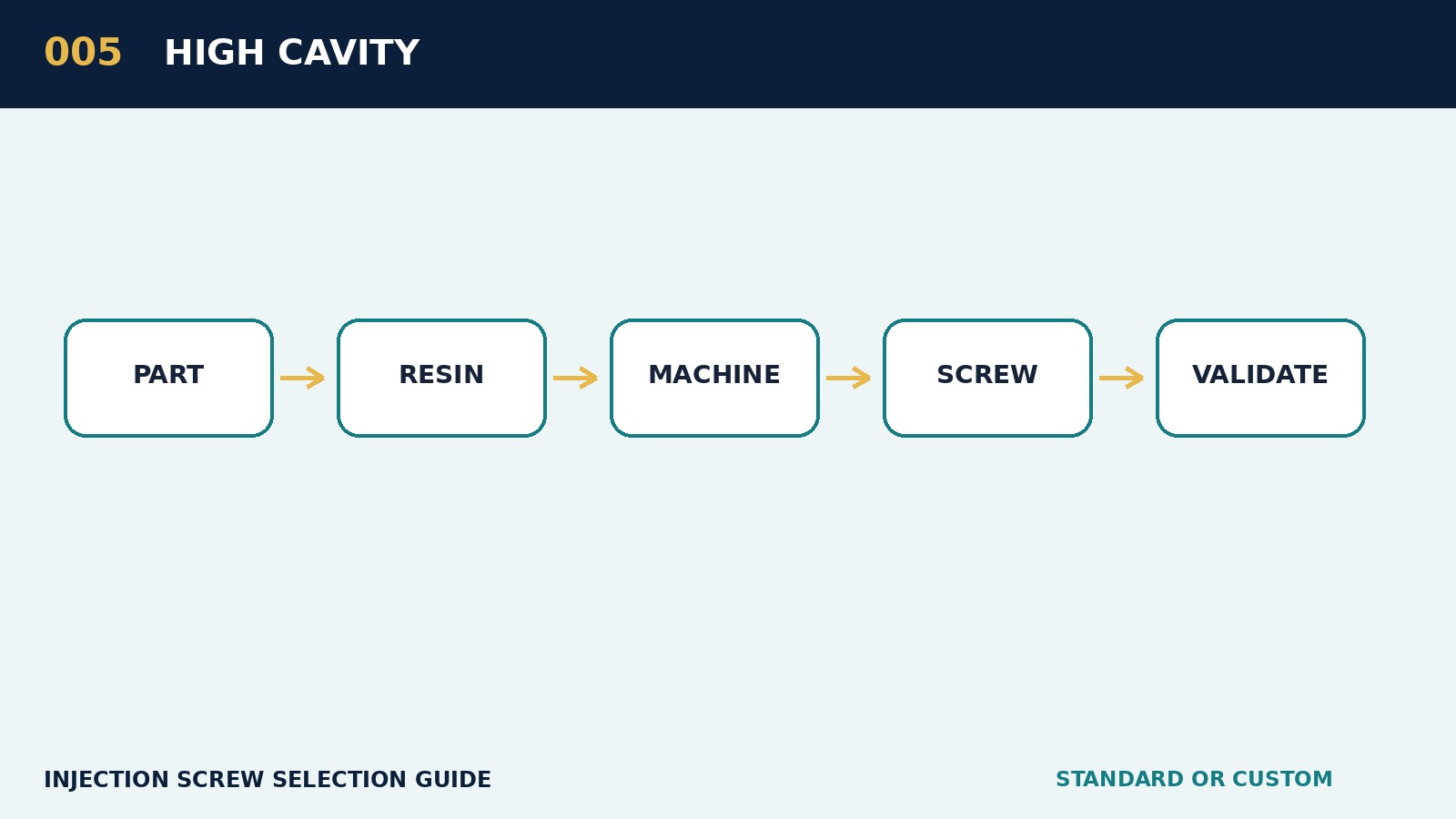
In the context of this project, it is proposed to use the line “Accounting screw and drive capacity per hour of plasticization needs”. First, to determine whether the available data support the choice, then to calculate the volume of reductive, pressure and plasticization, and finally to discuss the geometry, front-end components and material handling of the screws. If the standard programme is able to cover the window, priority should be given to the standard configuration; and if the risk of measurement of incompleteness or fluctuations in the weight of the dens remains due to insufficient plasticization, a dedicated structure should be proposed, with an indication of increased costs, delivery periods and expected benefits.
If it is done quickly and on an empirical basis, insufficient plasticization capacity results in incomplete measurements or fluctuations in the weights of the dens likely after delivery. The success of a single test module does not represent long-term stability, particularly for projects with high filling, high temperature, frequent colour change or multi-molecular co-plasms, and needs to look at changes in batches of material, the length of continuous production and the accumulation of wear and tear.
Ultimately, the programme should be judged by its cyclical rate of achievement and its very poor weight. If the result fails to meet the standard, each adjustment and result shall be recorded in five directions, by raw material, equipment, molds, process and screw, so as to avoid the loss of causal judgement by modifying multiple parameters at the same time. Therefore, the simple logic of “symmetrically-sized screw” should not be applied to high-density quail. Only by accounting for products, feedstocks, tonnages, voltage, screw diameter and target cycles will the standard screws have a clear scope of application and the dedicated screws have a reasonable design basis and return on investment.