
What's the line between the barrier and the blended screw?
Release time:2026-09-22
(c) Producing to the screw technology, describing the method of checking for the melting efficiency, slurry separation, colour dispersion and cut-off limits, analysing the risks that may not be in line with the project ' s objective solely because of the advanced name, and providing recommendations for validation based on the smelting or mixing of the main conflict structure and the smelting homogeneity, colour differential and yield.
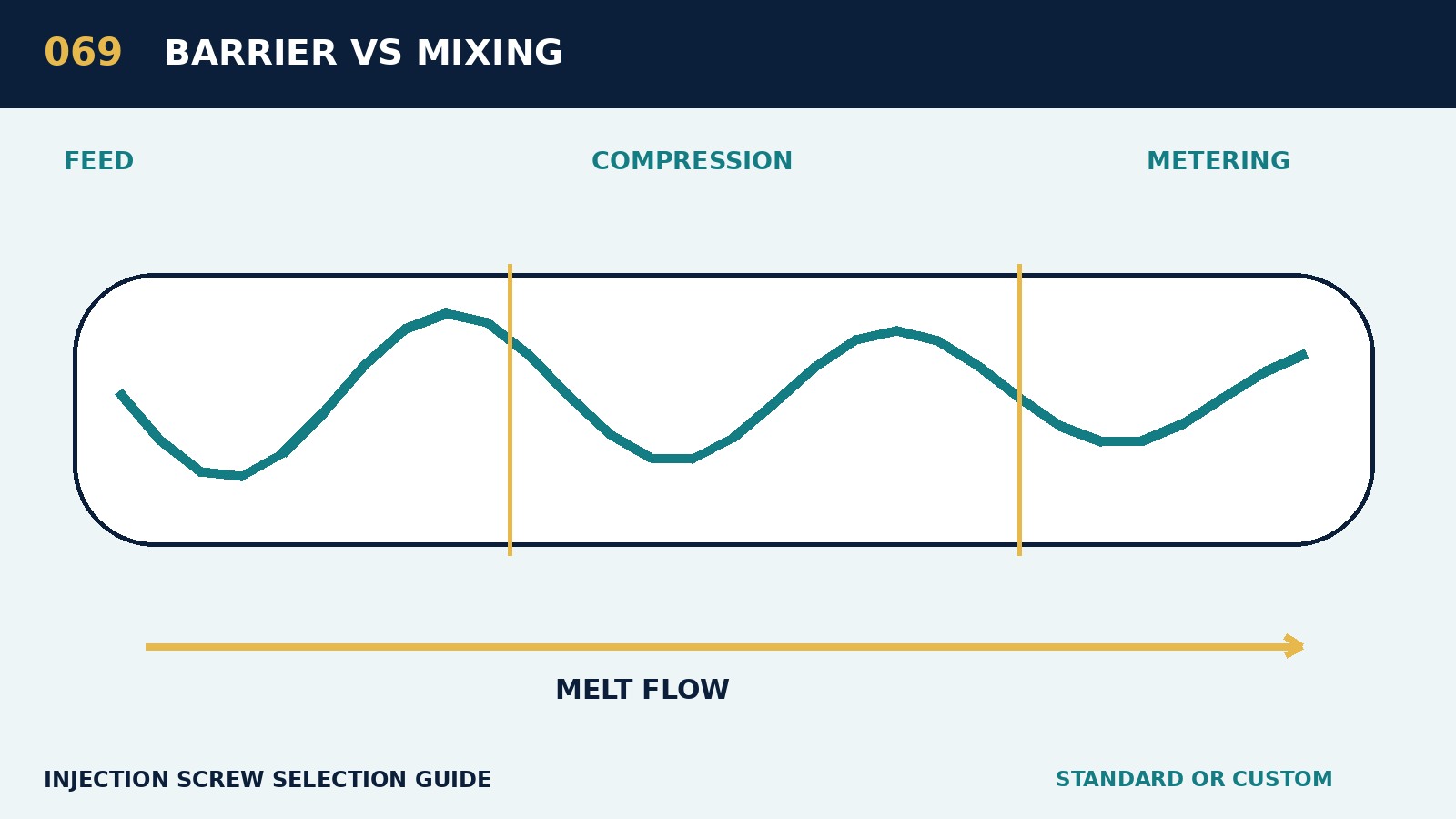
When projects involve barriers and condensing structures, the screw programme must start from the real production tasks of the client. The sale of screw technology requires the organization of melting efficiency, slurry separation, colour dispersion and cut-off restrictions into a set of verifiable, calculable and retroactive input conditions.
It's not absolutely good or bad. Standard schemes are appropriate for simple work, wide material windows and priority projects; the value of a dedicated structure is clear when materials are corrosive, corrosive, hot, sensitious or production requirements exceed the generic boundary. The judgement must be based on data and failure patterns. Material analysis cannot remain under PPP, ABS or PA names. The specific plate number, the percentage of the product or mineral filling, the flame-retarding system, the water-bearing requirements, the permitted stay time and the recommended processing temperature should be checked. Differences in the sensitivity of viscosity, wear, corrosiveness and shearing may be apparent in the broad categories of the same material, which change the compression ratio, the three-part ratio, alloy and surface treatment.
Site information should preferably include both photographs, short videos and data sheets. Photos are used to identify machine interfaces, screw tails and front-end components, video can be observed to measure, buffer and abnormal sound, and data tables are used to calculate the rate of application, the need for plasticization per hour and the length of stay. If only partial information can be obtained, a list should be provided for confirmation, rather than a tentative condition being a definitive conclusion. The focus of the discussion here is melting efficiency, slurry separation, colour dispersion and cut-off restrictions, which must correspond to the customer ' s current production conditions and not be limited to the maximum values in machine samples.
The configuration proposal should go to a choice structure based on melting or mixing of main contradictions, rather than using vague descriptions such as “enhanced” or “high performance”. The spiral drawings need to reflect the effective length, three-part scale, depth, compression ratio, tail connection and anti-reverse components; the material programme needs to distinguish the base, surface hardening, alloy layer or coating, and to indicate the pattern of failure for which they are intended.
Special vigilance is required that the selection of names solely because of their advanced name may be inconsistent with the project objectives. Many of the post-sale disputes arise from inconsistencies between the design input and the actual production conditions, such as the customer ' s replacement of the raw material number, the increase in the return rate or the transfer of the screw to another set of moulds, while still requiring the maintenance of the original acceptance results. The configuration of the boundary and change management should therefore be included in the technical document.
Ultimately, the programme should be judged for its objectives through melting evenly, colour differentials and production. If the result fails to meet the standard, each adjustment and result shall be recorded in five directions, by raw material, equipment, molds, process and screw, so as to avoid the loss of causal judgement by modifying multiple parameters at the same time. With the continuous accumulation of project data on barriers and mixing structures, the plant manufacturer could gradually establish a package, a trade charter and an aircraft-type menu to allow sales to quickly identify general and special conditions, while also placing a truly complex project under the timely review of application engineers.