
The relationship between the depth of the screwdriver transport segment and the stability of the particle feed
Release time:2026-09-20
The transport segment must form a stable solid plug and continuous supply without excessive friction to heat. From the principles of work, selection conditions, common risks and certification methods, the relationship between the depth of the rotor segment and the stability of the particle feed is explained, helping to stabilize the plastics plant and to reduce the full life cost of the screw drum.
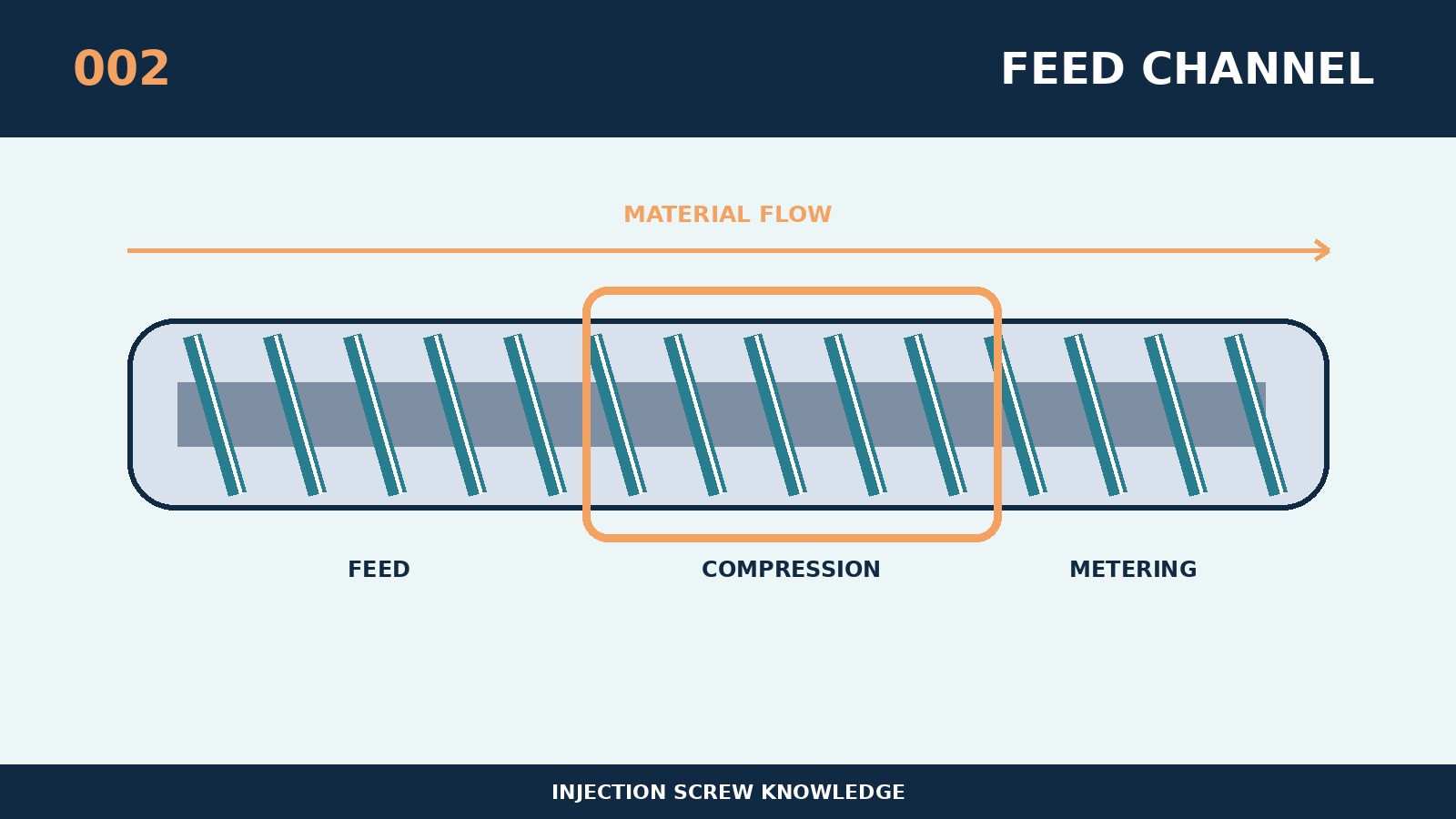
The relationship between the depth of the rotor segment and the stability of the particle feed is not an isolated parameter, but a key condition for influencing transport, temperature rise, pressure and repetition in the plasticization system. At its core is that the transport segment must form a stable solid plug and a continuous supply without excessive friction and heating. The friction between the inner walls of the drum and the particles is higher than the slide trend between the particles and the screws in order to push the material forward. Structural parameters are interconnected and any local modifications are evaluated in the complete path of transport, melting, mixing, metrology and cleaning. The selection programme should draw the boundary of production, temperature rise, twirl and time of stay before determining whether the parameter pushes the work to an uncontrolled area. Nominal specifications are therefore only the starting point, and the final conclusions must serve the actual resin, product and volume rhythm.
When customizing around the "relationship of the depth of the transmission segment and the stability of the particle feed", the equipment model, the original screw and the material drum are collected first, the actual dimensions, the driving capacity, the resin number and the filling system, the single mass, the cycle and the existing defects. The specific selection principles for this topic are the determination of the depth and surface state of the trough on the basis of particle shapes, stack density, lubricants, the proportion of refill powder and cooling conditions at the feed mouth. If the device can export a curve, the original record of screw position, turn speed, twist, back pressure and time should be kept, so as to avoid only being assessed by the operator. The technical agreement should include quantifiable provisions for size benchmarks, key communications, material status and acceptance methods so that new, old and subsequent restorations can be compared under the same criteria.
The most needed to guard against the failure of the subject is that the shallowness of the chute limits capacity and increases rectangularity, and that there is an empty turn, a bridge and a measurement time drift when the chute is too deep and the solid plug is not close. If abnormalities occur only in one of the resins, they should focus on their viscosity, filling, corrosiveness and recommended temperature and should not be directly classified as mechanical failure. For on-site processing, only one main variable is changed each time and the measurement time, twist, melting temperature, mat, injection pressure and product weight are aligned to the same pattern. If production is to be sustained by excessive temperature, turn speed or back pressure, the use of parameters to mask structures, wear or collage should be discontinued.
Validates the "relationship between the depth of the screwdriver segment and the stability of the particle feed" can be used as a replicable option: running in a series of new materials, in a range of fractions and in the worst batches, comparing the temperature of each modulus and the temperature of the feed. The screws, drums and reversible rings are proposed as side acceptances, since single-sizes do not represent a suitable axis of the combination gap with the heat. Inquiries to suppliers should also be accompanied by information on resins and fillings, risk of flame retardation or corrosion, total weight of products and fluids, photographs of available screws and equipment curves. The programme is considered to have a stable engineering value when the detection data, the good product rate, the timing of the switch and the unit cost of the eligible goods are improved.