
How do vendors use standard questionnaires to complete their first technical communication?
Release time:2026-09-22
(b) To provide a description of the methods used to check products, materials, platforms, moulds, processes and existing problems, to analyse the risk that only tonnage and prices will not lead to a reliable programme, and to provide recommendations for the validation of the use of the six-module questionnaire and the number of times key photographs or documents and information complete and quoted.
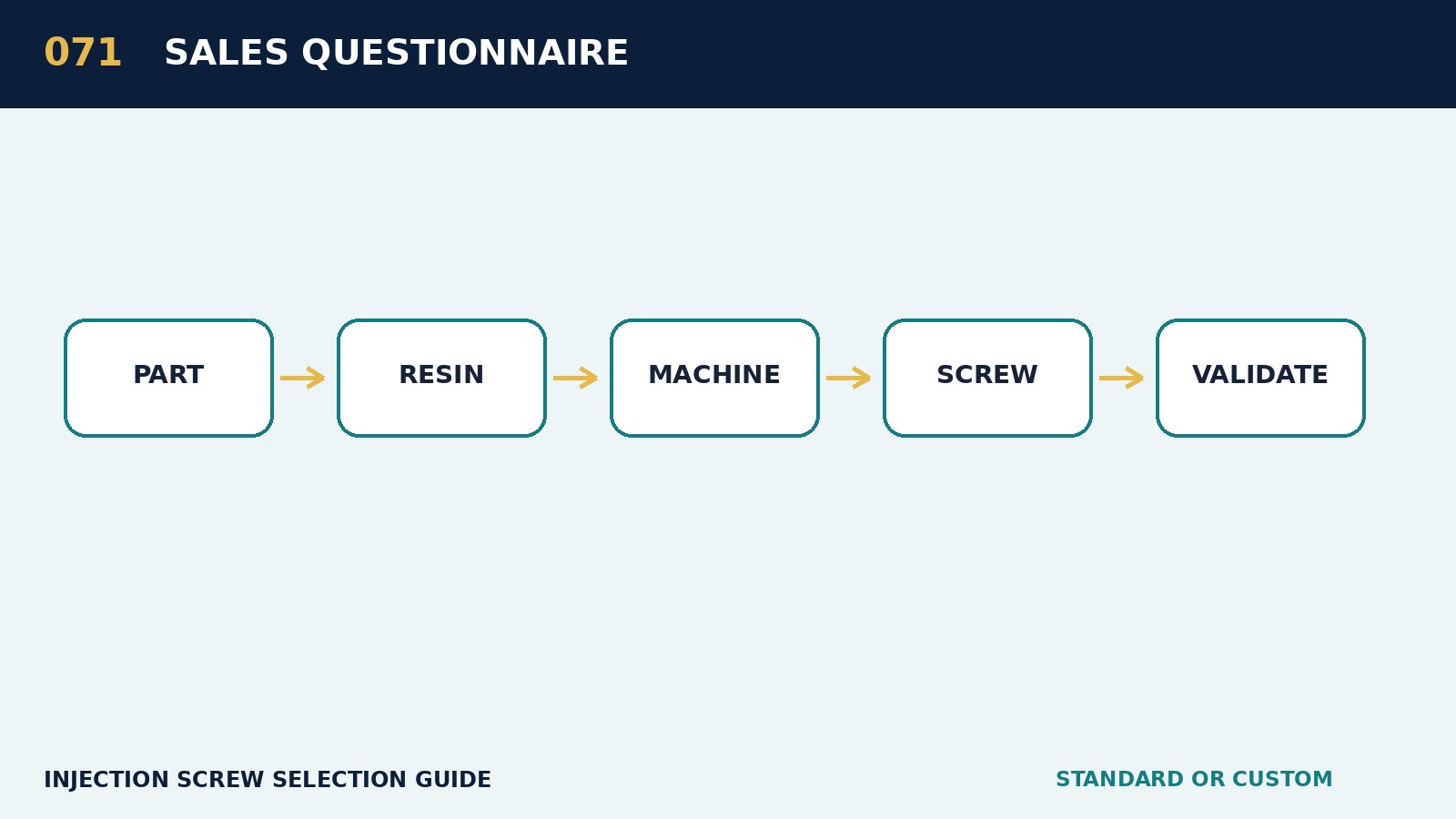
In the first technical communication, it was not the choice of an off-the-shelf model, but the identification of products, materials, platforms, moulds, processes and existing problems, that was first to be addressed by the vendor. This step determines whether the subsequent spiral diameter, structure and material grade are well founded.
The value of technology sales is to reduce the risk that customers will miss the equipment and accessories. Sales personnel need to close the demand questionnaire, technical evaluation, quotation boundaries, delivery nodes and post-sale recording, so that customers know what data each recommendation is based on, and that internal design and manufacturing teams have consistent information. Technical communication distinguishes between three types of objectives that must be met, desired improvement and acceptable. It is necessary to meet the hard boundary of the item for the determination of equipment and screws, and it is hoped that the improvement item will be used for the comparison of standards and specialized programmes, while the acceptable item will help to control costs and deadlines. This would avoid stacking all requirements on a screw and would make it easier for clients to understand the real value of each configuration.
Material analysis cannot remain under PPP, ABS or PA names. The specific plate number, the percentage of the product or mineral filling, the flame-retarding system, the water-bearing requirements, the permitted stay time and the recommended processing temperature should be checked. Differences in the sensitivity of viscosity, wear, corrosiveness and shearing may be apparent in the broad categories of the same material, which change the compression ratio, the three-part ratio, alloy and surface treatment. The focus of the discussion here is on products, materials, platforms, molds, processes and existing problems, and these data must correspond to the customer ' s current production conditions and cannot be cited only for the maximum value in the machine sample.
The six-module questionnaire could be used and key photographs or documents required as the backbone of the project, and a review of sales, design, process and customer participation could be arranged. The evaluation focused on the completeness of the input data, whether the assumptions were confirmed by the client, whether the mechanical interfaces were matched, how standards and specialized programmes were selected, and who provided the acceptance data.
Special vigilance is needed to ask only tonnage and prices that cannot lead to a reliable programme. Many of the post-sale disputes arise from inconsistencies between the design input and the actual production conditions, such as the customer ' s replacement of the raw material number, the increase in the return rate or the transfer of the screw to another set of moulds, while still requiring the maintenance of the original acceptance results. The configuration of the boundary and change management should therefore be included in the technical document.
Ultimately, the programme should be judged in terms of the information completeness rate and the number of round-trip offers. If the result fails to meet the standard, each adjustment and result shall be recorded in five directions, by raw material, equipment, molds, process and screw, so as to avoid the loss of causal judgement by modifying multiple parameters at the same time. Where the information is temporarily incomplete, the pre-selection scope and the list to be confirmed may be provided, but it should not be considered a final commitment. The freeze of the configuration after the customer has completed the product, material, platform, mould, process and existing problems can reduce the number of false orders and facilitate the production, testing, installation and sale of the same version of data.