
What kind of start-up support should be provided by the vendor after the screw is delivered
Release time:2026-09-22
After the sale and sale of accessories, describe the method of checking the baseline of the installation, air transfer, heating, freshware, process, analyse the risk that direct full-load production will magnify the installation or material problem, and provide recommendations for validation of the implementation and recording of the success rate and stabilization time of the first start on a phased list.
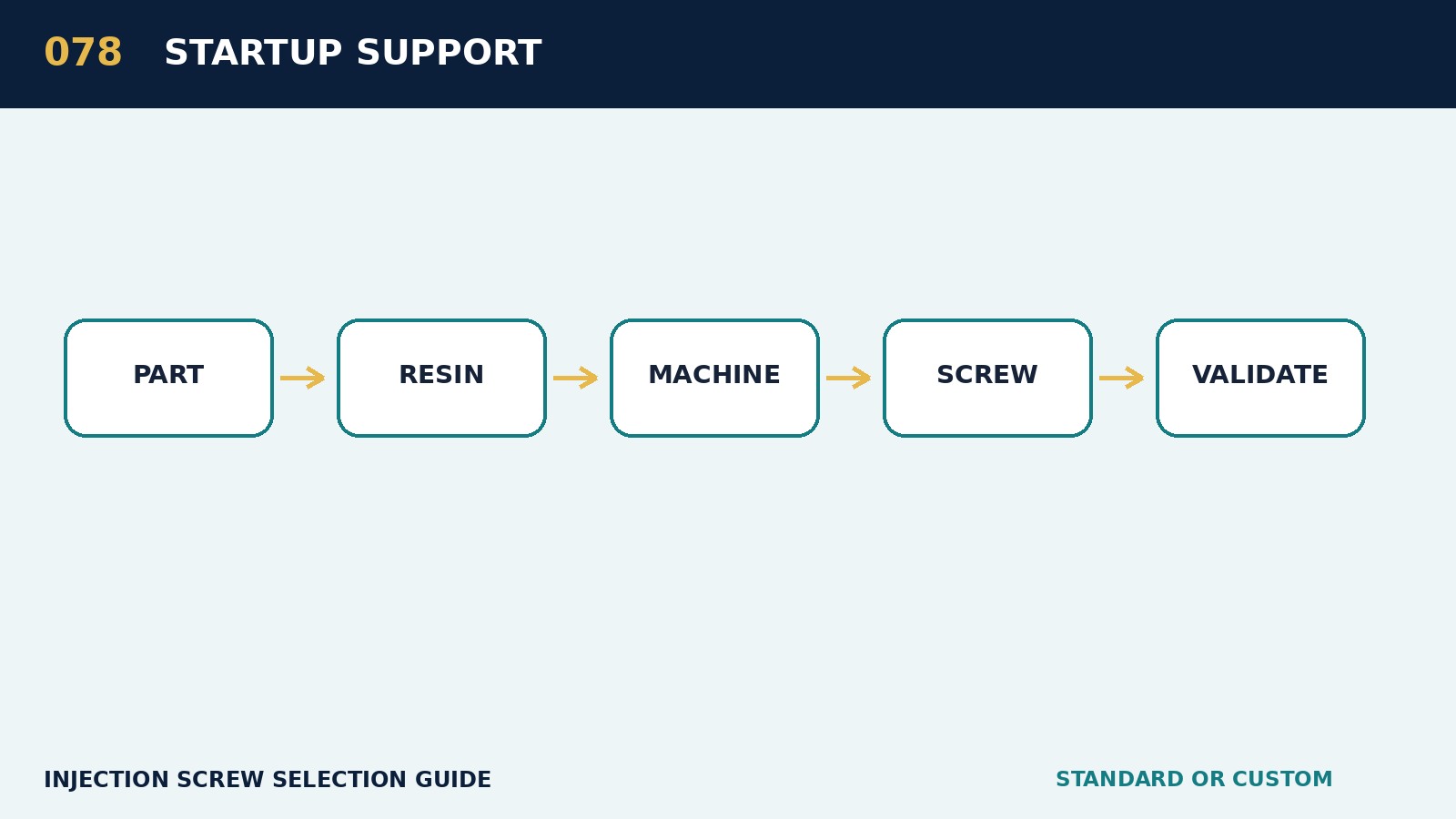
Delivery appears to be a conventional equipment selection and is more likely to result in deviations due to installation checks, air rotations, heating, fresh materials, process baselines not being evaluated at the same time. For the sale and sale of spare parts, the correct approach would be to establish a situational baseline before discussing specific configurations.
The value of technology sales is to reduce the risk that customers will miss the equipment and accessories. Sales personnel need to close the demand questionnaire, technical evaluation, quotation boundaries, delivery nodes and post-sale recording, so that customers know what data each recommendation is based on, and that internal design and manufacturing teams have consistent information. It is recommended that customer information be broken down into five groups: products and moulds, raw materials, platforms, process objectives and existing problems. Product end logs of single weight, flowway, number of caves, wall thickness and appearance levels; ratio of feedstock end recorder number, melting finger, filling, flame retardation and retrofitting; terminal logs of tonnage, voltage, screw diameter, maximum travel, injection pressure and plasticization. All data are sourced and are marked, drawn, physical, measured or estimated by clients.
Site information should preferably include both photographs, short videos and data sheets. Photos are used to identify machine interfaces, screw tails and front-end components, video can be observed to measure, buffer and abnormal sound, and data tables are used to calculate the rate of application, the need for plasticization per hour and the length of stay. If only partial information can be obtained, a list should be provided for confirmation, rather than a tentative condition being a definitive conclusion. The focus of the discussion here is on installation inspections, air rotation, heating, cooling, process baselines, which must correspond to the customer ' s current production conditions and not be limited to the maximum values in machine samples.
The implementable options are implemented and documented on a phased basis. The quoted documents should include both the applicable raw materials, the range of recommended voltage, the permitted turn-off and back pressure, the size of the interface, the material and thermal treatment, and the need for re-evaluation when marking subsequent changes to the material or the mould by the client. This would prevent the use of earmarked programmes in completely different conditions.
The main risk of the scene is that direct full-load production will magnify installation or material problems. The issue of whether or not to be derived from a screw should first be excluded from drying, heating ring, thermal voltage, nozzles, reversible rings, wear and tearing of the material drums and changes in process parameters. The use of exclusions is more reliable than the direct replacement of components and also protects the time and cost of both the seller and the client.
The acceptance is recommended as a primary indicator of the success rate and the time of stabilization for the first start, with the simultaneous recording of temperature, screw velocity, back pressure, measurement position, buffer position, injection peak pressure and continuous sample weight for all areas of the drum. At least three reasonable process points, low, medium and high, are covered to confirm that the programme is not effective under a single parameter. With the continued accumulation of project data for the start-up, the equipment manufacturer could gradually establish a package, a trade charter and an aircraft-type menu to allow sales to quickly identify general and special conditions and to submit a truly complex project to the application engineer for evaluation in a timely manner.