
How to avoid loss of information when equipment is sold and transferred to a technical team
Release time:2026-09-22
For the equipment vendor sales team, describe the method of checking the original needs, commitments, samples, data and unconfirmed matters, analyse the risk that oral handovers will result in repeated queries or erroneous commitments, and provide recommendations for verification of the uniform project number and technology transfer forms and the number of technical omissions and changes.
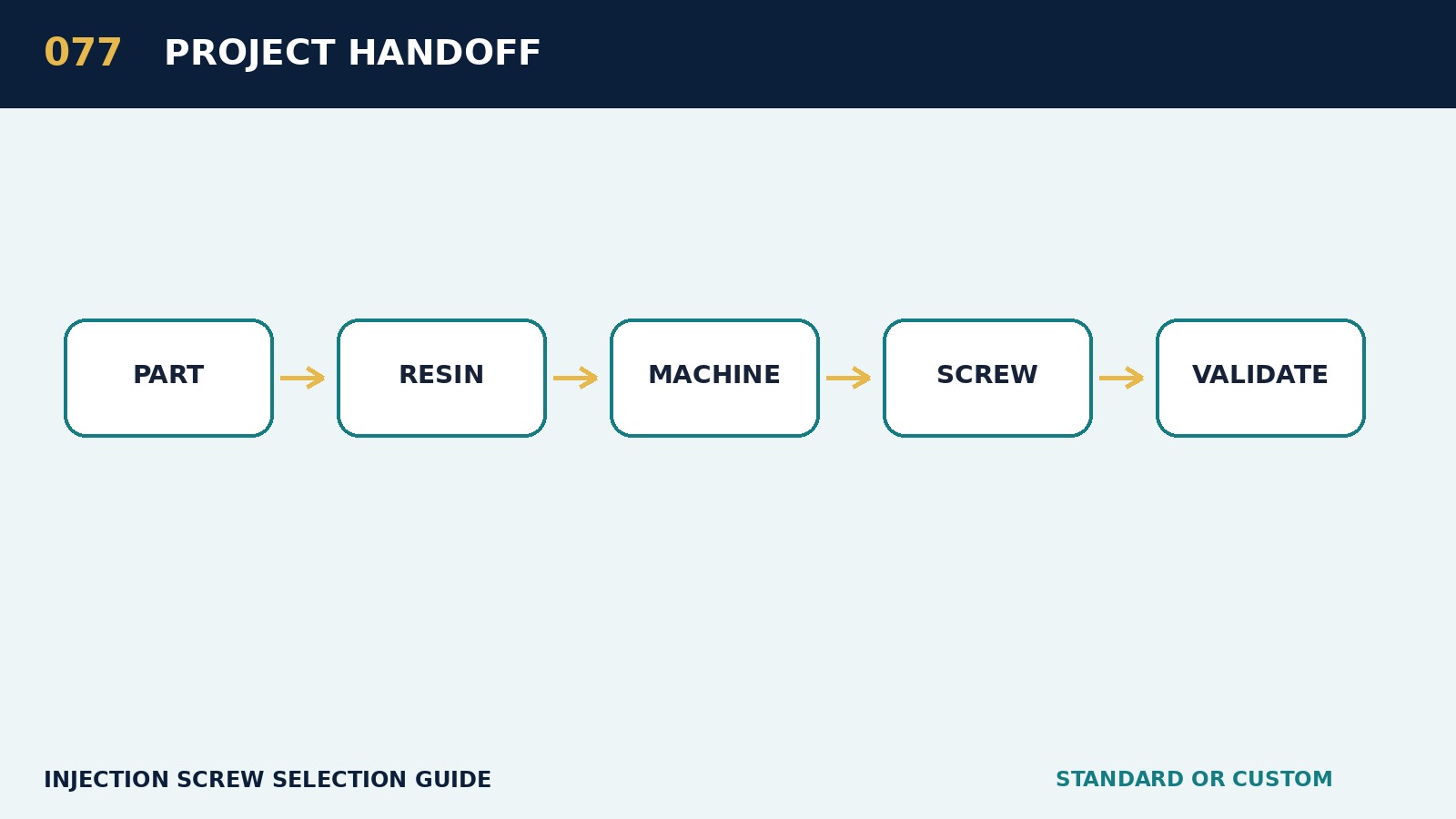
In response to project handovers, customers often ask for prices or deadlines, but the equipment vendor sales team should first check the original requirements, commitments, samples, data and unrecognized matters. Only by quantifying these conditions can the standard screws have an interpretable boundary with the choice of a dedicated screw.
The value of technology sales is to reduce the risk that customers will miss the equipment and accessories. Sales personnel need to close the demand questionnaire, technical evaluation, quotation boundaries, delivery nodes and post-sale recording, so that customers know what data each recommendation is based on, and that internal design and manufacturing teams have consistent information. It is recommended that customer information be broken down into five groups: products and moulds, raw materials, platforms, process objectives and existing problems. Product end logs of single weight, flowway, number of caves, wall thickness and appearance levels; ratio of feedstock end recorder number, melting finger, filling, flame retardation and retrofitting; terminal logs of tonnage, voltage, screw diameter, maximum travel, injection pressure and plasticization. All data are sourced and are marked, drawn, physical, measured or estimated by clients.
Site information should preferably include both photographs, short videos and data sheets. Photos are used to identify machine interfaces, screw tails and front-end components, video can be observed to measure, buffer and abnormal sound, and data tables are used to calculate the rate of application, the need for plasticization per hour and the length of stay. If only partial information can be obtained, a list should be provided for confirmation, rather than a tentative condition being a definitive conclusion. The focus of the discussion here is on original needs, commitments, samples, data and unrecognized matters, which must correspond to the customer ' s current production conditions and cannot be based solely on the maximum value in the machine sample.
The implementable option is to harmonize project numbers with technical interface tables. The quoted documents should include both the applicable raw materials, the range of recommended voltage, the permitted turn-off and back pressure, the size of the interface, the material and thermal treatment, and the need for re-evaluation when marking subsequent changes to the material or the mould by the client. This would prevent the use of earmarked programmes in completely different conditions.
If the above steps are ignored, the most common consequence is that oral handovers can result in repeated inquiries or erroneous commitments. The problems are often manifested in the trial phase of measuring time instability, insufficient stress residuals, buffer drift, unmelted, black spots, colour differentials or increased wear and tear. Continued increase in temperature, back pressure and turn speed at this time may temporarily improve the appearance, but may increase the shearing heat, material degradation and equipment load.
Ultimately, the programme should be judged by the number of omissions and technical changes. If the result fails to meet the standard, each adjustment and result shall be recorded in five directions, by raw material, equipment, molds, process and screw, so as to avoid the loss of causal judgement by modifying multiple parameters at the same time. For aluminum manufacturers and vendors, professionalism is reflected in the ability to translate the client language into engineering parameters and to interpret the programme into production, quality, maintenance and cost results that the client can understand. The establishment of a standard process around the handover of projects will not only improve the accuracy of this selection but also result in a reusable machine and application database.