
How the fine little piece project assesses the repertoire precision of the screw measure
Release time:2026-09-22
For precision plating manufacturers, describe the method of checking micro-jet, resolution measurement, reversibility and material stability, analyse the risks of excessive screws resulting in too short a journey to measure fluctuations and amplification, and give recommendations for the validation of the control of the use of the voltage and the selection of high-repeated reversible structures and product weight Cpk to measure position fluctuations.
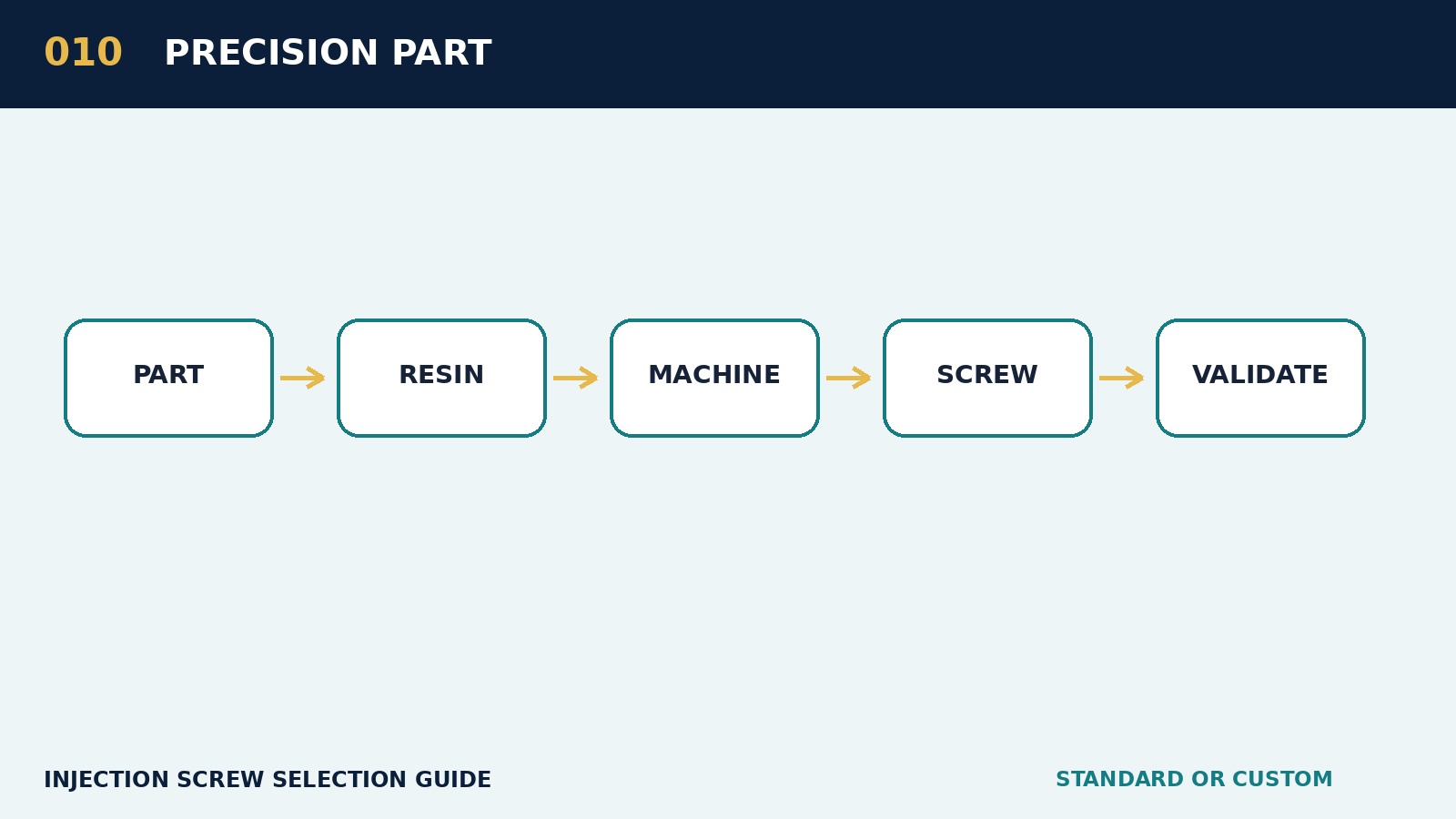
The problem with many sophisticated small-scale projects is not the lack of equipment capacity, but the omission of micro-jet, measuring resolution, reversibility and material stability at the selection stage. The risk of subsequent re-engineering and complaints can be significantly reduced if the precision-specified plastic manufacturer completes the technical confirmation prior to the offer.
The core of the demand phase is not to immediately give a screw model, but to convert the client ' s product target into a calculable data. Product weights, project sizes, wall thickness, flow ratio, number of lacquers, flow weights, material plates and target cycles must be placed in the same record; if one of them has not been identified by the customer, it should be clearly marked as a hypothesis and the sales calibre should not be mistaken for final technical condition. Site information should preferably include both photographs, short videos and data sheets. Photos are used to identify machine interfaces, screw tails and front-end components, video can be observed to measure, buffer and abnormal sound, and data tables are used to calculate the rate of application, the need for plasticization per hour and the length of stay. If only partial information can be obtained, a list should be provided for confirmation, rather than a tentative condition being a definitive conclusion.
It is recommended that customer information be broken down into five groups: products and moulds, raw materials, platforms, process objectives and existing problems. Product end logs of single weight, flowway, number of caves, wall thickness and appearance levels; ratio of feedstock end recorder number, melting finger, filling, flame retardation and retrofitting; terminal logs of tonnage, voltage, screw diameter, maximum travel, injection pressure and plasticization. All data are sourced and are marked, drawn, physical, measured or estimated by clients. The focus of discussion in this paper is on micro-jet, resolution measurement, reversibility and material stability, which must correspond to the customer ' s current production conditions and not be limited to the maximum values in machine samples.
An implementable option would be to control the utilization of volatilizers and to choose a highly repetitious reversible structure. The quoted documents should include both the applicable raw materials, the range of recommended voltage, the permitted turn-off and back pressure, the size of the interface, the material and thermal treatment, and the need for re-evaluation when marking subsequent changes to the material or the mould by the client. This would prevent the use of earmarked programmes in completely different conditions.
The cost of the misconfiguration is not only the screw itself, but also the cut-off, the waste of raw materials, the testing of molds, the delay in delivery and the credibility of customers. Precautionary measures built around too small a spiral to allow for too short a measurement and increased volatility are more economical than re-routing after problems have arisen; the vendor can then move from a mere offerer to a partner that can take the technical screening.
Upon completion of the project, the result of the delivery was a product mass Cpk and the measurement of position fluctuations, and the size tests, material or heat treatment certificates, trial modelling records and maintenance recommendations were archived. Sales teams can return after three months or a ton agreement to compare plasticization time, energy consumption, product fluctuations and wear and tear trends. The sales proposal should answer three questions at the same time: why this selection was made, which conditions had changed and which were re-selected, and how the customer validated the results. Clearing up these three issues would allow for the transformation of a fine piece from a spare parts trade to a traceability technology project.