
What's going to happen if the compression is too short or too long?
Release time:2026-09-22
(b) For the Apostilles development and sales team, which describes the method of checking the melting rate, gas excretion, cut-off peaks and material sensitivity, analyses the risk of overheating of compressed mutations and underutilization of the length of excess equipment, and gives recommendations for the verification of the length of the compressed segment and the temperature curve, black dots and unmelting by material melting behaviour.
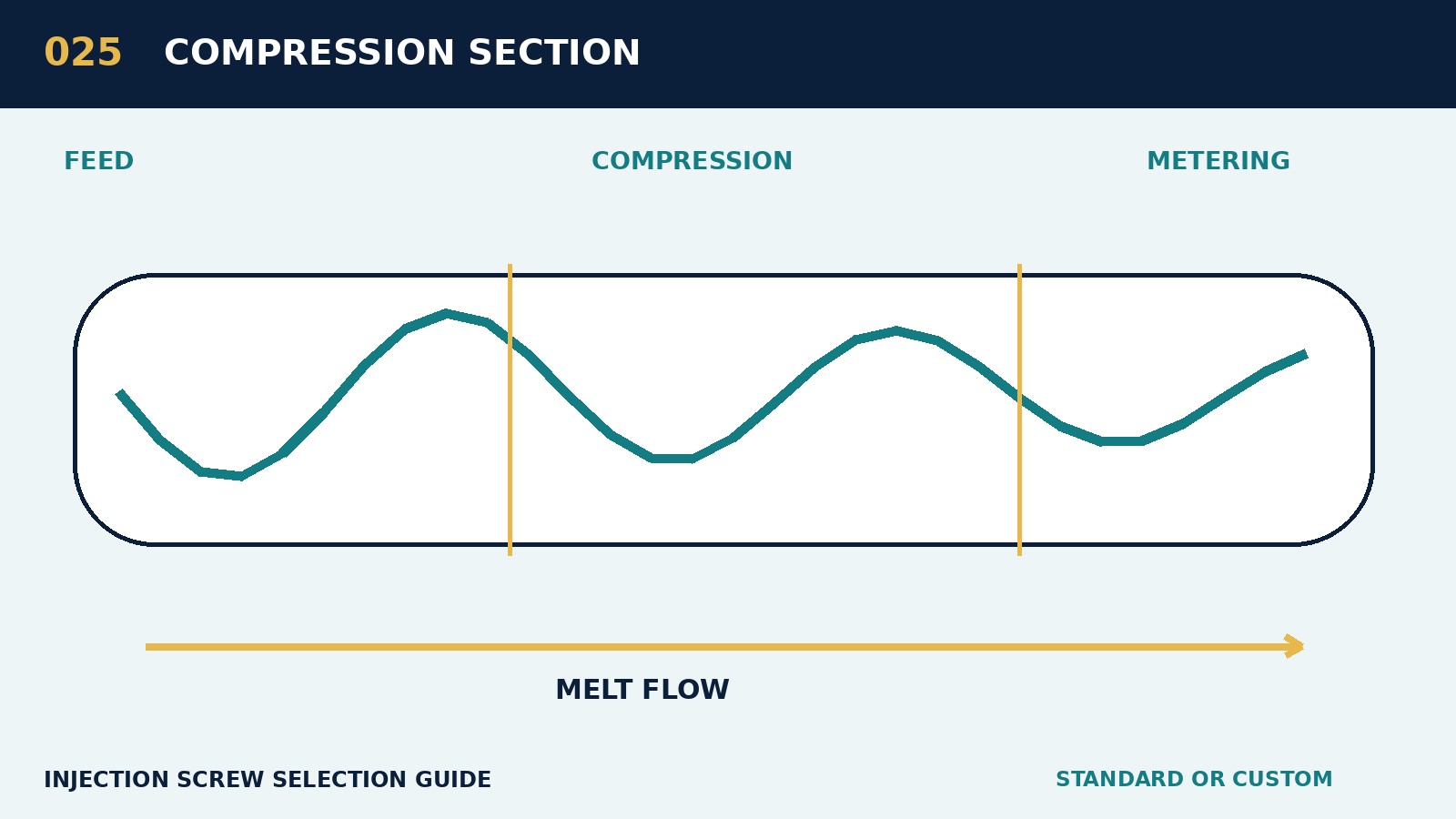
The problem with many compression sector design projects is not the lack of equipment capacity, but rather the omission of melting rates, gas emissions, cutting peaks and material sensitivity during the selection phase. A technical confirmation by the research and development and marketing team of the retrofits can significantly reduce the risk of re-engineering and complaints.
Each size of the screw structure serves solid transport, melting, refining, measuring and injection sealing. The diameter, long-range ratio, three-part ratio, depth, compression ratio and front-end components need to be considered as a system; local parameters appear to be stronger and do not represent the raw materials and cycles of the package that are more suitable for customers. Technical communication distinguishes between three types of objectives that must be met, desired improvement and acceptable. It is necessary to meet the hard boundary of the item for the determination of equipment and screws, and it is hoped that the improvement item will be used for the comparison of standards and specialized programmes, while the acceptable item will help to control costs and deadlines. This would avoid stacking all requirements on a screw and would make it easier for clients to understand the real value of each configuration.
It is recommended that customer information be broken down into five groups: products and moulds, raw materials, platforms, process objectives and existing problems. Product end logs of single weight, flowway, number of caves, wall thickness and appearance levels; ratio of feedstock end recorder number, melting finger, filling, flame retardation and retrofitting; terminal logs of tonnage, voltage, screw diameter, maximum travel, injection pressure and plasticization. All data are sourced and are marked, drawn, physical, measured or estimated by clients. The focus of discussion in this paper is the melting rate, gas emissions, cut-off peaks and material sensitivity, which must correspond to the customer ' s current production conditions and not be limited to the maximum values in machine samples.
From a sales management point of view, the distribution of compression segments by material melting behaviour should form a standard process that can be repeated. Each project saves original needs, computations, final drawings, test modelling data and client feedback, and can call on experience in the event of a similar machine or material, but there is still a need to reconcile key differences and not to copy the historical configuration directly.
The main risk of the scene is overheating of compressed mutations and underutilization of equipment lengths. The issue of whether or not to be derived from a screw should first be excluded from drying, heating ring, thermal voltage, nozzles, reversible rings, wear and tearing of the material drums and changes in process parameters. The use of exclusions is more reliable than the direct replacement of components and also protects the time and cost of both the seller and the client.
The focus of the validation was on the temperature curve, black spots and unmelted materials. The test shall use the actual material and representative moulds of the client, retaining the batch number, dry condition, ambient temperature and sample number. When compared to old schemes, equipment, moulds and major process conditions other than screws should be as consistent as possible. For aluminum manufacturers and vendors, professionalism is reflected in the ability to translate the client language into engineering parameters and to interpret the programme into production, quality, maintenance and cost results that the client can understand. The creation of standard processes around compressed segments will not only improve the accuracy of this selection, but also create reusable machine and application databases.