
How to design a blend when the colour mother and additives are dispersed at a high level
Release time:2026-09-22
For equipment application engineers, describe the verification method for dispersing mass, cutting caps, back pressure and cycle, analyse the risk of insinuation of coloured points, excessive warming and degradation, and provide certification recommendations for the configuration of moderate mixing elements and for the verification of temperature rises and colour differentials, dispersion and temperature.
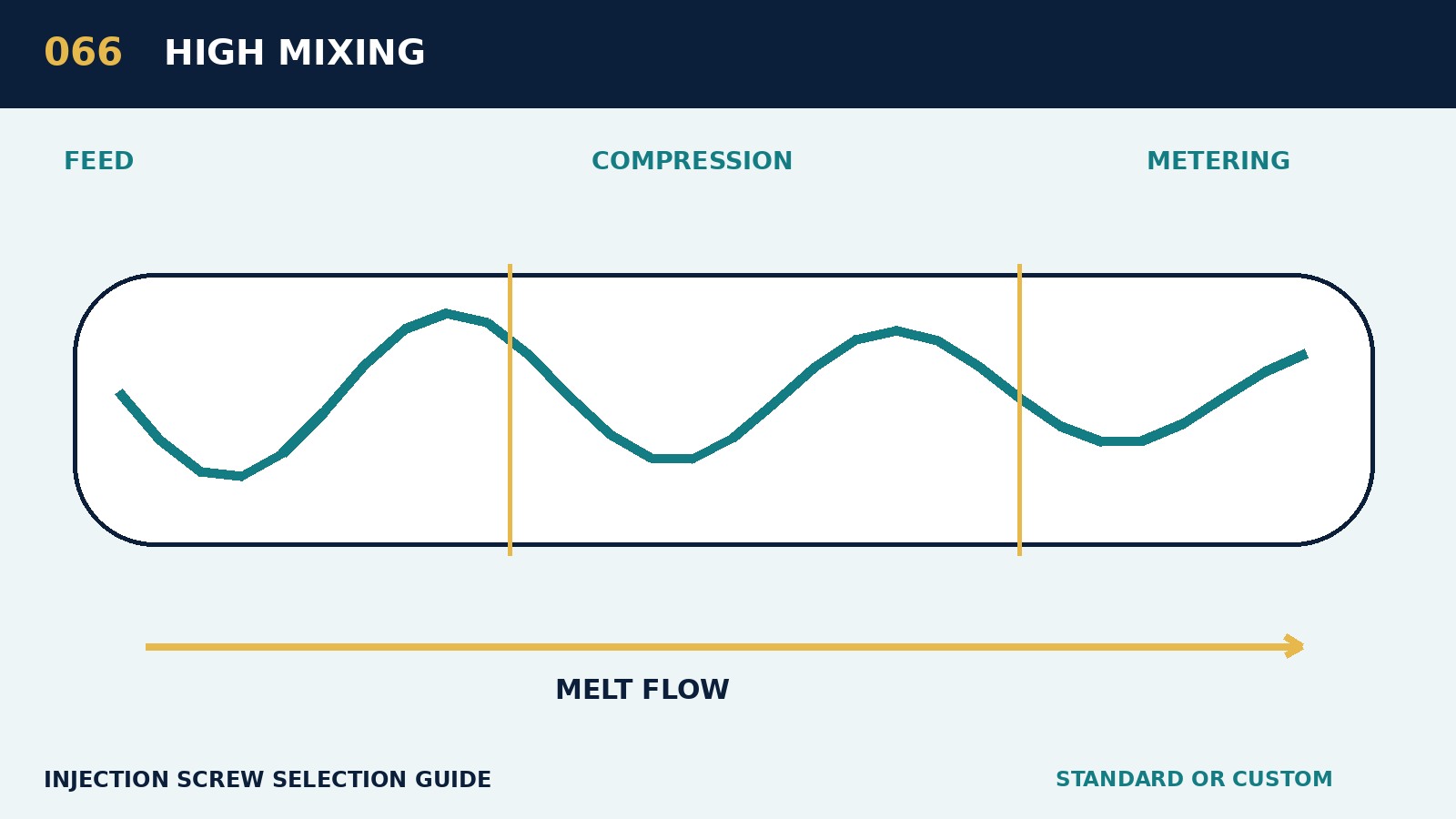
In the high-mixing demand, equipment application engineers do not first have to address the choice of an off-the-shelf model, but rather the identification of diffuse mass, cut ceilings, back pressure and cycle. This step determines whether the subsequent spiral diameter, structure and material grade are well founded.
It's not absolutely good or bad. Standard schemes are appropriate for simple work, wide material windows and priority projects; the value of a dedicated structure is clear when materials are corrosive, corrosive, hot, sensitious or production requirements exceed the generic boundary. The judgement must be based on data and failure patterns. Material analysis cannot remain under PPP, ABS or PA names. The specific plate number, the percentage of the product or mineral filling, the flame-retarding system, the water-bearing requirements, the permitted stay time and the recommended processing temperature should be checked. Differences in the sensitivity of viscosity, wear, corrosiveness and shearing may be apparent in the broad categories of the same material, which change the compression ratio, the three-part ratio, alloy and surface treatment.
Technical communication distinguishes between three types of objectives that must be met, desired improvement and acceptable. It is necessary to meet the hard boundary of the item for the determination of equipment and screws, and it is hoped that the improvement item will be used for the comparison of standards and specialized programmes, while the acceptable item will help to control costs and deadlines. This would avoid stacking all requirements on a screw and would make it easier for clients to understand the real value of each configuration. The focus of discussion in this paper is on dispersing quality, cutting caps, back pressure and periodicity, which must correspond to the customer ' s current production conditions and cannot be limited to the maximum values in machine samples.
The configuration proposal should go to the configuration of the moderate mixing element and verify the temperature increase, rather than using vague descriptions such as “enhanced” or “high performance”. The spiral drawings need to reflect the effective length, three-part scale, depth, compression ratio, tail connection and anti-reverse components; the material programme needs to distinguish the base, surface hardening, alloy layer or coating, and to indicate the pattern of failure for which they are intended.
If the above-mentioned steps are ignored, the most common consequence is a lack of chromosomality and excessive temperature rise and degradation. The problems are often manifested in the trial phase of measuring time instability, insufficient stress residuals, buffer drift, unmelted, black spots, colour differentials or increased wear and tear. Continued increase in temperature, back pressure and turn speed at this time may temporarily improve the appearance, but may increase the shearing heat, material degradation and equipment load.
The focus of the validation was on colour differentials, dispersion and temperature. The test shall use the actual material and representative moulds of the client, retaining the batch number, dry condition, ambient temperature and sample number. When compared to old schemes, equipment, moulds and major process conditions other than screws should be as consistent as possible. The sales proposal should answer three questions at the same time: why this selection was made, which conditions had changed and which were re-selected, and how the customer validated the results. Clearing up these three issues would make it possible to move from a trade in spare parts to a traceability technology project.