
How do you adjust the screws when they don't spread well?
Release time:2026-09-22
For equipment application engineers, describe the method of verification of the chromosomal carrier, add-up ratio, colour parity and cut-off limits, analyse the risk that blind increase in back pressure increases the temperature increase and the cycle, and give recommendations for validation of the application of moderate mixing of components and optimization of the measurement segment, colour difference, colour point and plasticization time.
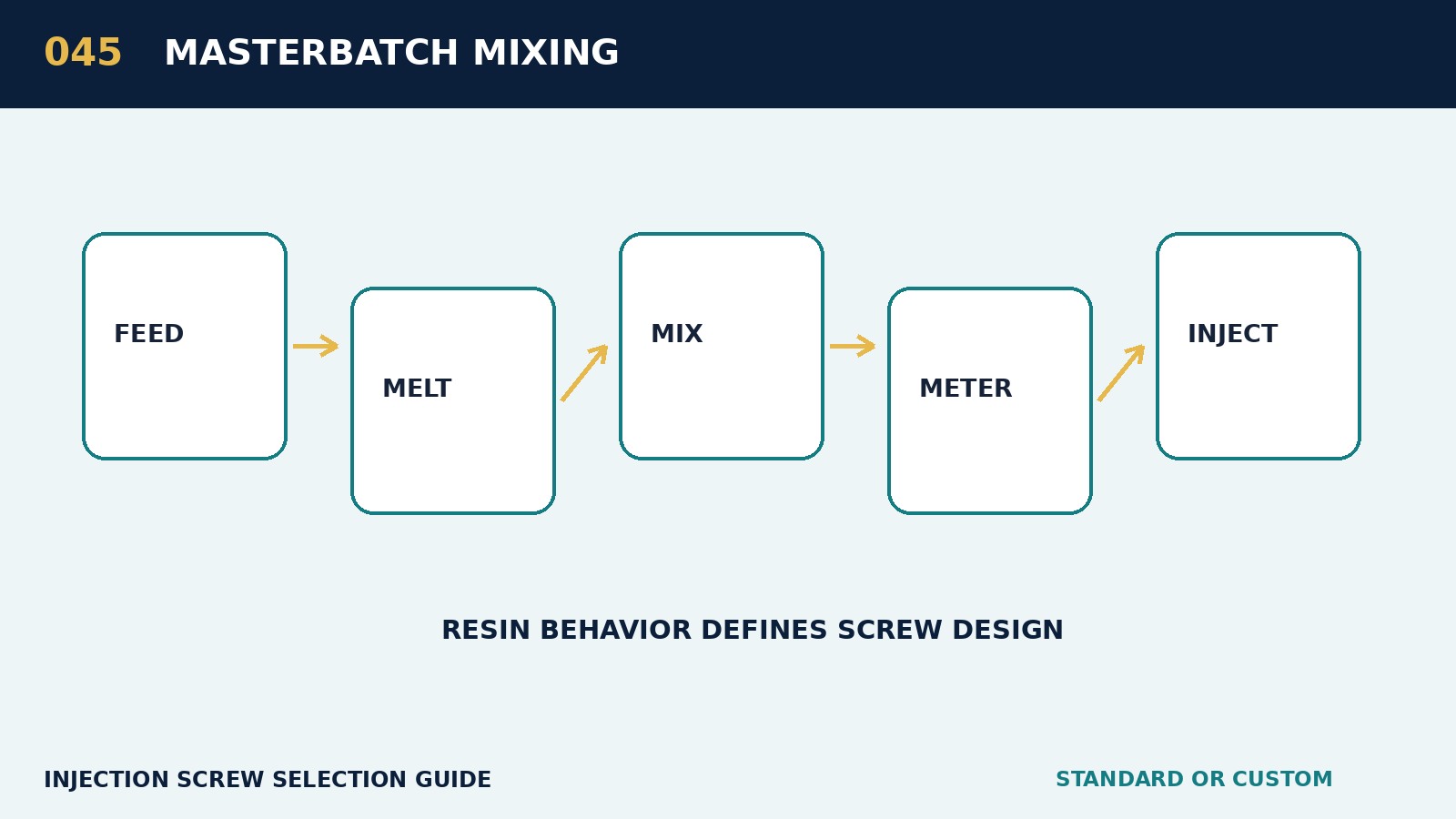
The problem with many of the parent-segregated projects is not the lack of equipment capacity, but the omission of the colour carrier, the addition ratio, the even colours and the cut limits at the selection stage. Equipment application engineers can significantly reduce the risk of re-engineering and complaints if they complete the technical confirmation prior to the offer.
Additions and fillings change the demand for currents, frictions, wear, corrosion and mixing. The configuration is not limited to additions, but also focuses on particle form, carrier, fibre length, decomposition products and batch fluctuations; where necessary, the screws, drums, retroring, nozzles and dry delivery systems are evaluated together. Material analysis cannot remain under PPP, ABS or PA names. The specific plate number, the percentage of the product or mineral filling, the flame-retarding system, the water-bearing requirements, the permitted stay time and the recommended processing temperature should be checked. Differences in the sensitivity of viscosity, wear, corrosiveness and shearing may be apparent in the broad categories of the same material, which change the compression ratio, the three-part ratio, alloy and surface treatment.
Site information should preferably include both photographs, short videos and data sheets. Photos are used to identify machine interfaces, screw tails and front-end components, video can be observed to measure, buffer and abnormal sound, and data tables are used to calculate the rate of application, the need for plasticization per hour and the length of stay. If only partial information can be obtained, a list should be provided for confirmation, rather than a tentative condition being a definitive conclusion. The focus of the discussion here is on the chromosomal carrier, addition ratio, colour parity and cut-off limits, which must correspond to the customer ' s current mass production conditions and not be limited to the maximum values in machine samples.
In the context of this project, it is proposed to adopt the approach of “the use of moderate mixing of components and optimization of measurement segments”. First, to determine whether the available data support the choice, then to calculate the volume of reductive, pressure and plasticization, and finally to discuss the geometry, front-end components and material handling of the screws. If the standard scheme is able to cover the window, priority should be given to the standard configuration; if blindly increased back pressure increases the risk of warmer and more cyclical, the risk remains, and a dedicated structure is proposed, with an indication of increased costs, delivery and expected benefits.
The main risk of the scene is that blindly increasing back pressure increases the temperature and cycle. The issue of whether or not to be derived from a screw should first be excluded from drying, heating ring, thermal voltage, nozzles, reversible rings, wear and tearing of the material drums and changes in process parameters. The use of exclusions is more reliable than the direct replacement of components and also protects the time and cost of both the seller and the client.
Ultimately, the programme should be judged by colour differentials, colours and plasticization time. If the result fails to meet the standard, each adjustment and result shall be recorded in five directions, by raw material, equipment, molds, process and screw, so as to avoid the loss of causal judgement by modifying multiple parameters at the same time. Therefore, the simple logic of “symmetrically-sized screw” should not be applied to the chromosomal fusion. Only by accounting for products, feedstocks, tonnages, voltage, screw diameter and target cycles will the standard screws have a clear scope of application and the dedicated screws have a reasonable design basis and return on investment.