
Which parts make up the screw head and what role each plays.
Release time:2026-09-20
The common screw head component consists of screw head, anti-reverse ring and pushring ring, which is responsible for circulation, sealing and transmission of the injection load. The principle of work, selection conditions, common risk and validation methods indicate which parts the screwhead component consists of and their respective roles in helping to stabilize the retrofitting plant and to reduce the full life cost of the bolt cylinder.
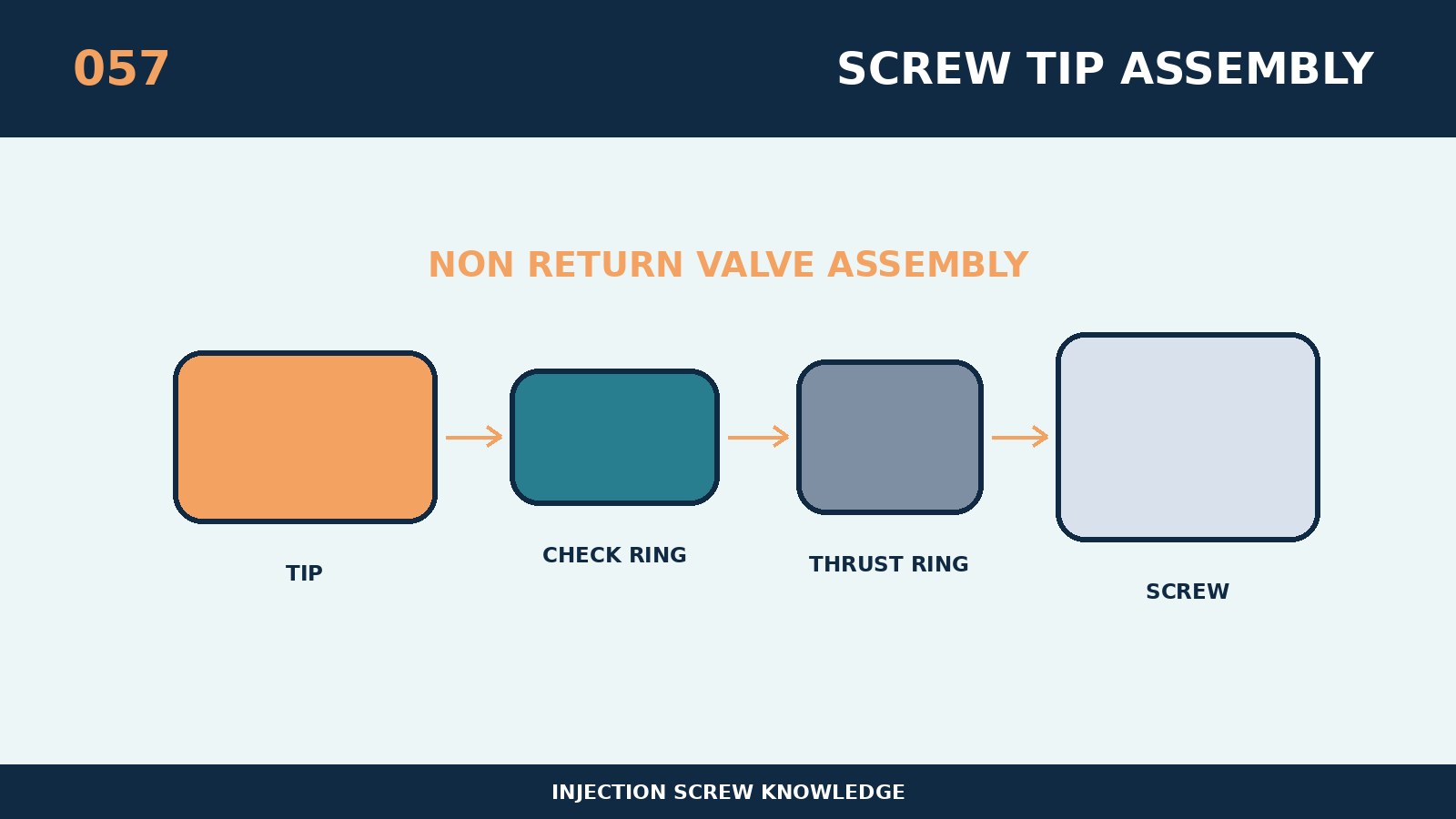
It is not an isolated parameter, but a key condition for influencing transmission, temperature rise, pressure and repetition in a plasticization system. At its core is the common screw head component consisting of a screwhead, an anti-reverse ring and a pushring ring, which is responsible for the circulation, sealing and transmission of the injection load. The anti-ring opening during plasticization allows the molten body to enter the front end, and when injected, the flow is restricted by pressure differential. The screwhead and the reversible ring are at the front end of high pressure, high temperature and fast-forward, and their mobility, sealing, strength and cleanness must be met simultaneously. It is recommended that the snails be expanded and the axle-sized chain compared to the material melting route, so that it can be seen which area is actually carrying the transmission, pressure or amalgamation function. Nominal specifications are therefore only the starting point, and the final conclusions must serve the actual resin, product and volume rhythm.
When customizing around “what parts are made of the screw head components and what roles are assigned to them”, the equipment model, the original screw and the material drum are first collected for measuring dimensions, driving capacity, resin plate numbers and filling systems, single mass, cycle and existing defects. The specific selection principles for this topic are: design to match the screw diameter, material viscosity, speed of fire, pressure, cleaning requirements and front-end space. The specimen shall keep the batch of raw materials, the baking conditions and the mold cooling, and shall determine the spiral reaction by measuring the time, peak twist and actual melting temperature. The technical agreement should include quantifiable provisions for size benchmarks, key communications, material status and acceptance methods so that new, old and subsequent restorations can be compared under the same criteria.
The most needed to guard against the failure of the subject is: the dead end of the trajectories, the failure to cooperate or the lack of strength that causes the black spot, the return flow, the loss of pressure and the fracture of the parts. A curved envelope of the normal package should be created to see if the abnormal cycle occurs at the feed, later-storage, injection start or voltage stage. For on-site processing, only one main variable is changed each time and the measurement time, twist, melting temperature, mat, injection pressure and product weight are aligned to the same pattern. If production is to be sustained by excessive temperature, turn speed or back pressure, the use of parameters to mask structures, wear or collage should be discontinued.
This replicable option can be used to verify “the parts of the screw head component which are made up of and the respective roles of the screw head component”: the strips and wear and tear bands are examined and validated through replication of seals, mats and products. The screws, drums and reversible rings are proposed as side acceptances, since single-sizes do not represent a suitable axis of the combination gap with the heat. Inquiries to suppliers should also be accompanied by information on resins and fillings, risk of flame retardation or corrosion, total weight of products and fluids, photographs of available screws and equipment curves. The programme is considered to have a stable engineering value when the detection data, the good product rate, the timing of the switch and the unit cost of the eligible goods are improved.