
How to incorporate stoppage losses into the screwdriver selection investment decision
Release time:2026-10-02
For end-of-pipe retrofitting plants, talk about how to integrate downtime losses into screw-selection investment decisions, combining product, raw materials, platform, production, life-cycle and life-cycle data to reduce the cost of scrap, shutdown and life-cycle.
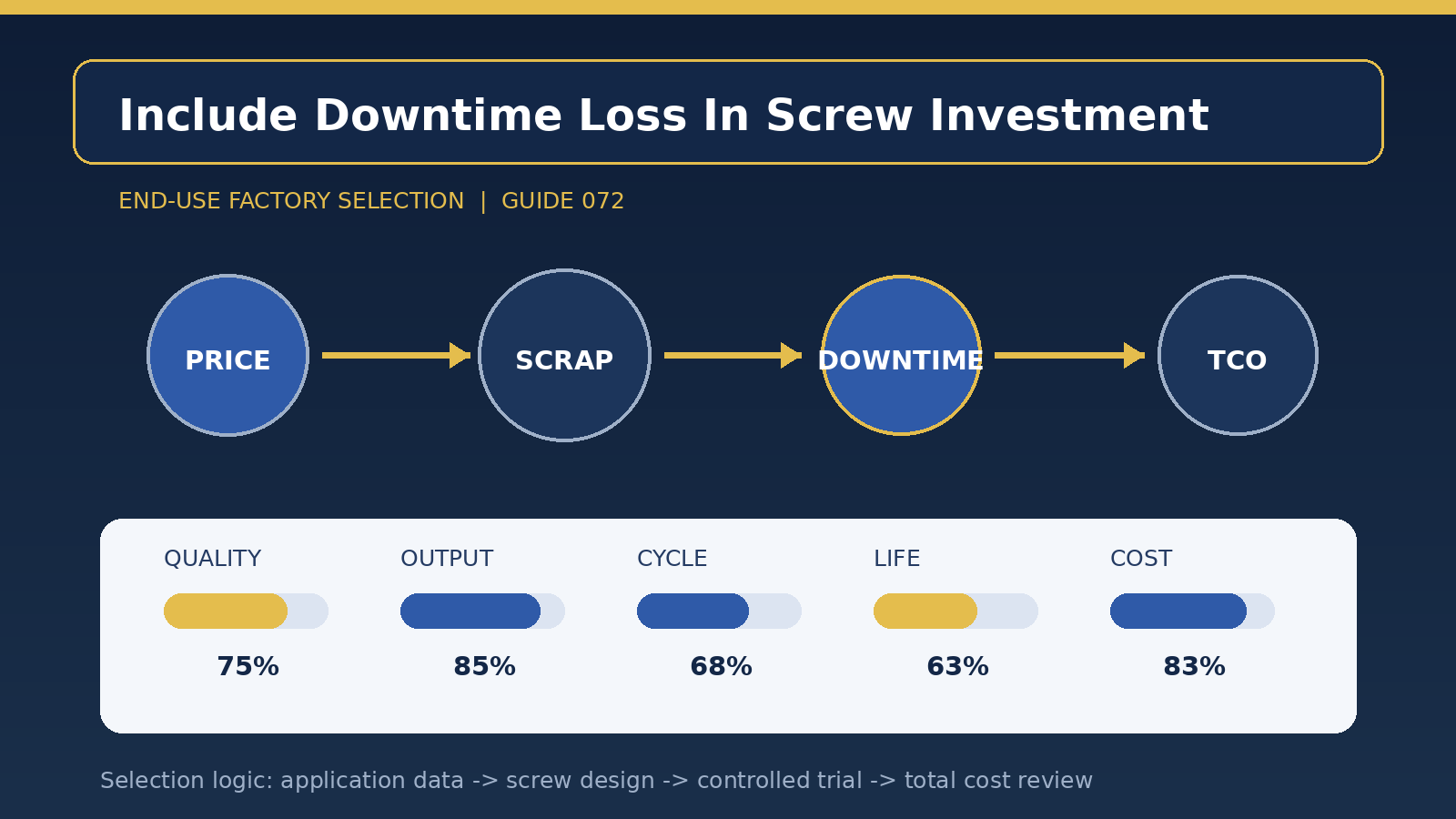
[Scene definition] How to integrate stoppage losses into a screwdriver-selected investment decision is to start from the real volume scene of the plant and not just the diameter of the screw or the price. It is recommended that the purchase price, scrap, energy consumption, stoppage and spare parts be first collated and then that the data be observed at a single, hourly and three scales per 10,000 items. The aim of this step is to establish comparable old programme benchmarks so that subsequent screw changes can be supported by data.
The most easily ignored of the topic is the cost of a single eligible item and the full life cycle. The plant should bind its planned lifetime to the annual operating hours, the type of material and the frequency of maintenance, and break the daily production down into class beats, time available and loss of modelling. Vendors can make retroactive trade-offs between interoperability, earmarking and cost when there are clear values for product weight, daily production, customer quality caps and allowed stop times.
[Design Focus] The main line of this case is to replace the simple price with TCO and the current cycle. In the geometry and materials programme, the retrofitting, reflowing and screwhead residual areas should be checked; and the depth of the feed section should be checked for stable delivery, while avoiding feeder docking. The final solution would also need to be compatible with the wear and tear of the cylinder, the drive, the physical velocity and the current cleaning process, and would not cover up co-operation or process problems with a single high-level material.
The new [comparison-valid] program proposes a minimum of 12 hours of continuous operation, with a 60-module extraction for each stabilization phase, to record the temperature of the entropy, the size of the product, and the single energy consumption. The test shall be co-signed by the production, quality and equipment triangulations, which shall not allow for a single sector to be independently shaped, and shall be kept under normal ceiling loads for sufficient time to observe the twisting, temperature and measurement drift. If only the first one is checked, it is easy to miss the risks associated with heat drifting, material stoppage, reversal loop return and prolonged wear and tear.
When the [stabilized production] spiral is shaped, the abnormal twister, storage timeout and material volume rebound shall be set up as an early overhaul signal, and the key platform shall be prepared for a screw head component or spare parts package, and its serviceability shall be reviewed on a regular basis. The time of storage, back pressure, screw velocity, noise and mass of the product shall be recorded in a uniform manner in the shift. When the above indicators change at the same time, the mechanical gaps and the state of the raw materials should be checked before the process is adjusted to avoid the use of parameters to compensate for hardware degradation.
The [comprehensive cost] cost table should not be a single spiral price, but should set three life-cycle scenarios that are optimistic, benchmark and conservative, so as to prevent a single hypothesis from magnifying the return on investment, and set a minimum production threshold for a dedicated screw, re-comparable when production is insufficient. It is recommended that the cost per 10,000 eligible items be exported simultaneously, the cost per 1,000 operating hours and the estimated number of return months. When new programmes reduce waste, refuelling or sudden shutdowns, higher initial inputs are often offset during production.
The [Closed Ring Management] will eventually include drawing numbers, screwdriver materials, heat treatment, critical dimensions, portable tubes, process windows and acceptance data in the curriculum vitae cards. It is recommended that a reference set of data be maintained before and after maintenance to determine wear and tear trends, and that a maximum number of repairs be set for each removal and surface thickness recorded for the refurbishment. When there is a significant change in the feedstock formulation, retrospection ratio, product structure or target node, the applicable boundary of “how to integrate stoppage losses into a screwdriver investment decision” should be reassessed, rather than defaulting that the old conclusion is permanent.
Topic: Energy consumption, good rates and combined costs