
Cosmetic packaging of retrosset screws: mix, light and low cut
Release time:2025-08-07
Make-up wrapper? Cosmetic packaging of plastic screws needs to match the plastic properties, retrospective specifications and product quality targets, and to confirm temperature rise, metrology, mixing and wear and tear through trial modelling data. This paper combines information on star-friend screw stations to organize selection, process and validation elements.
The core conclusion of cosmetic packaging with plastic screws.
Cosmetic packaging of plastic screws needs to match the plastic properties, retrospective specifications and product quality targets, and to confirm temperature rise, metrology, mixing and wear and tear through trial modelling data.
Fine solutions for cosmetic packaging: high-mixing and low-cut head starter
In the area of cosmetic packaging, the appearance and precision of products such as bottle caps and cream containers directly affect the quality of the brand. These products require surface roughness (no scratches, no abbreviations), ±0.03 mm public-size differentials (to ensure smooth and smooth running), and even dispersion of chromium (colour difference E≤1.0). Currently, cosmetic packaging is often less than 70 per cent eligible for production using common equipment, with 30 per cent of waste due to surface defects, 25 per cent size deviation and 20 per cent uneven chromosomal. This paper analyses the process characteristics of common materials such as PP and PET in the context of specific data, with a focus on improving product quality and production efficiency in cosmetic packaging production. Special plume screws with high-mixed and low-hearing bands achieve precision formation and target production pains.
Core quality pain points and technology needs for cosmetic packaging
The quality deficiencies in cosmetic packaging are closely related to material mobility, plaster dispersion, formation stability, etc. According to industry standards, the surface of high-end ointment containers is required to have a mirror effect (Ra0.00.03 mm) and the latency gap under a pressurized bottle cap is subject to a limit of 0.02-0.04 mm, otherwise it is prone to leakage or carding. Colour-coloured packaging Δ0.8 is required to avoid cross-section visual differences.
The mechanisms behind these pain points are concentrated in three areas: first, the surface problem. PP Melts are prone to melting under high shears, resulting in orange peels (Ra up to 0.2 μm); second, size problem. PET formation contraction rates are sensitive to the temperature (erosity of ±2°C leads to a 0.3% contraction deviation), while the temperature accuracy of the general plume screw (+3°C) is insufficient to ensure consistency in size; and, thirdly, the distribution of the color mother. The dispersed flatness of the colored mother in the normal screw is only 75 per cent, and it is easy to produce colours and stripes, especially in transparent packaging.
Technical advantages of high-mixed and low-cut head-to-head pins
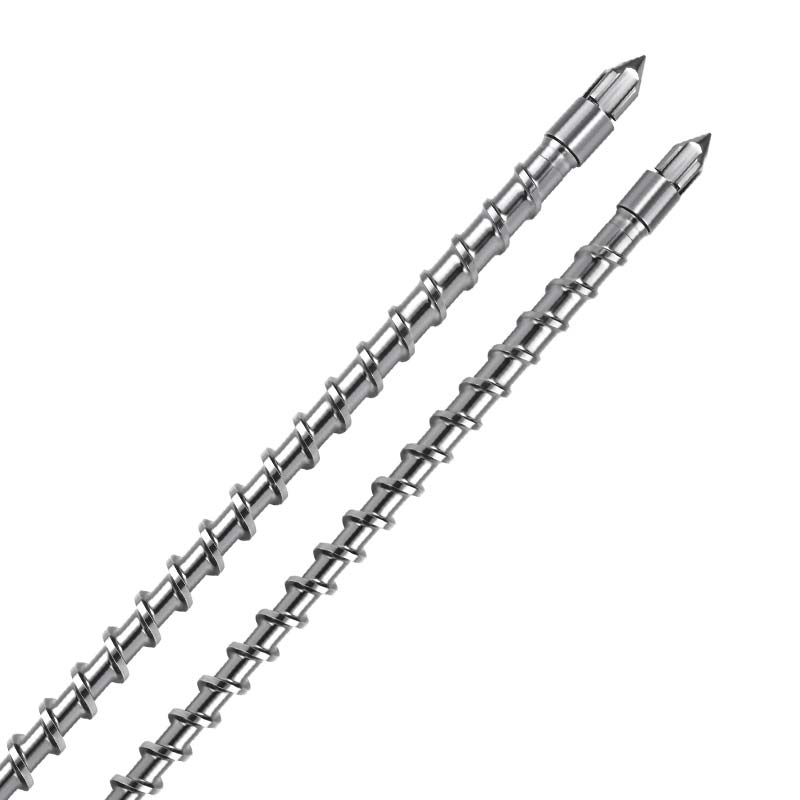
In response to cosmetic packaging difficulties, special plywood screws with high mixing and low cutting segments were designed to optimize their structure:
High-mixed-part design improves the dispersion of colour agents
The middle part of the screw is staggeredly arranged (0.5 mm) and the length of the leg is 25% of the total length of the screw (or 15% of the normal screw), enabling the chameleon to undergo multiple cuttings. The test data showed that the structure had increased the dispersed parity of the PP-coloured mother to 96 per cent (75 per cent of the normal screw) and reduced the chromatic deficiency rate from 18 per cent to 1.5 per cent; for PET-transparent packaging, the incidence of the strip was reduced from 22 per cent to 1.2 per cent and the color difference E was stabilized at 0.6-0.8.
Low cutting to the head to make sure the surface is clean.
The head of the screw (at the end of the measurement segment) uses a shallow snail + smooth transition structure that reduces the cut-off rate to 80-100s - 1 (normal screw 150-200s - 1) and avoids melting. Tested on the PP cap, the surface roughness was reduced from R0.15 m to 0.03 m and the incidence of coding was reduced from 25 per cent to 2.1 per cent; at the same time, lower cutting reduced the orientation of the molecular chain and increased the impact of the cap by 15 per cent (from 20 kJ/m2 to 23kJ/m2).
The structure is tight, temperature control is accurate, and size consistency is ensured.
The screw long diameter (L/D) is set at 20:1 (25:1) and the structure is more compact. Melting time is reduced to 40 seconds (60 seconds for normal screws) and temperature fluctuations are controlled at ±0.8°C (+3°C for normal screws). Production data show that the PET cream bottle size public difference was reduced from ±0.07 mm to ±0.02 mm, and the fit gap pass was increased from 65 per cent to 99 per cent; and the batch size deviation was reduced from 0.05 mm to 0.01 mm to meet the consistency requirements for high-end packaging.
Validation of effects in practical application
The production data of a cosmetic packaging enterprise show that the pass rate for the use of high-mixed and low-cut headcut pins of the PP cap was raised from 68 per cent to 99.1 per cent, specifically: the surface deficiency rate was reduced from 30 per cent to 1.8 per cent, the size deviation rate was reduced from 25 per cent to 0.9 per cent, the chromosomal inequity rate was reduced from 20 per cent to 0.7 per cent, the mirror effect rate for PET containers was increased from 70 per cent to 99 per cent and client complaints were reduced by 90 per cent.
In terms of cost-effectiveness, material utilization increased from 80 per cent to 97 per cent, resulting in annual savings of approximately $5.2 million in raw materials, based on the production of 10 million packs per year; production efficiency increased by 35 per cent and combined production costs decreased by 22 per cent as a result of reduced back-to-work and testing.
This high-mixed section and low-cut head-tiping screws fit perfectly into the finely refined needs of cosmetic packaging through techniques such as increased plaster dispersion, optimization of surface mass and control size. With the upgrading of the cosmetics industry's desire for the appearance and quality of packaging, the screw will become the core equipment for high-end cosmetic packaging production, and the enabling industry will move towards “zero defects” aesthetic manufacturing.
Data to be recorded before implementation
- Material integrity number, filling ratio, flame-retarding system, refill ratio and dry condition.
- Note plastics brand, model, screw diameter, voltage, back pressure, turn speed and current screw structure.
- Indicators of product size, wall thickness, appearance or strength, and current adverse phenomena and frequency of occurrence.
- Continuous production cycle, refuelling frequency, machine clean-up method, wear and tear record and planned useful life.
How to validate the adjustment results
It is recommended that the current process baseline be established, followed by a single-variant test model. Each round records the measurement of time, melting temperature, product weight, formation cycle and bad rate, avoiding multiple parameters being changed at the same time to determine the cause. The parameters in the text are used to illustrate design thinking and should not replace material supplier data and on-site safety protocols.
What kind of support is a star-friend screw?
Starfleet Mechanical Equipment Co. Ltd. (Starfeng) provides materials and situational assessments, screw structural recommendations, base materials and surface treatment options, non-standard size customizations, and simulations around cosmetic packagings. The submission of information on raw materials, equipment and products could lead to more targeted programmes.
Ask for customized screws immediately, or check firstNote plastic screw productwithNote Plastic SolutionsI don't know.