
Which performances to take into account when choosing a screw for carbon fibre material
Release time:2026-09-22
For high-end equipment sales teams, describe the method of checking conductivity, erosion, fibre length and dispersion, analyse the risk of excessive cutting to damage fibres and change performances, and provide recommendations for validation of grinding structures in combination with thermal mixing design and fibre retention, conductivity and mechanical performance.
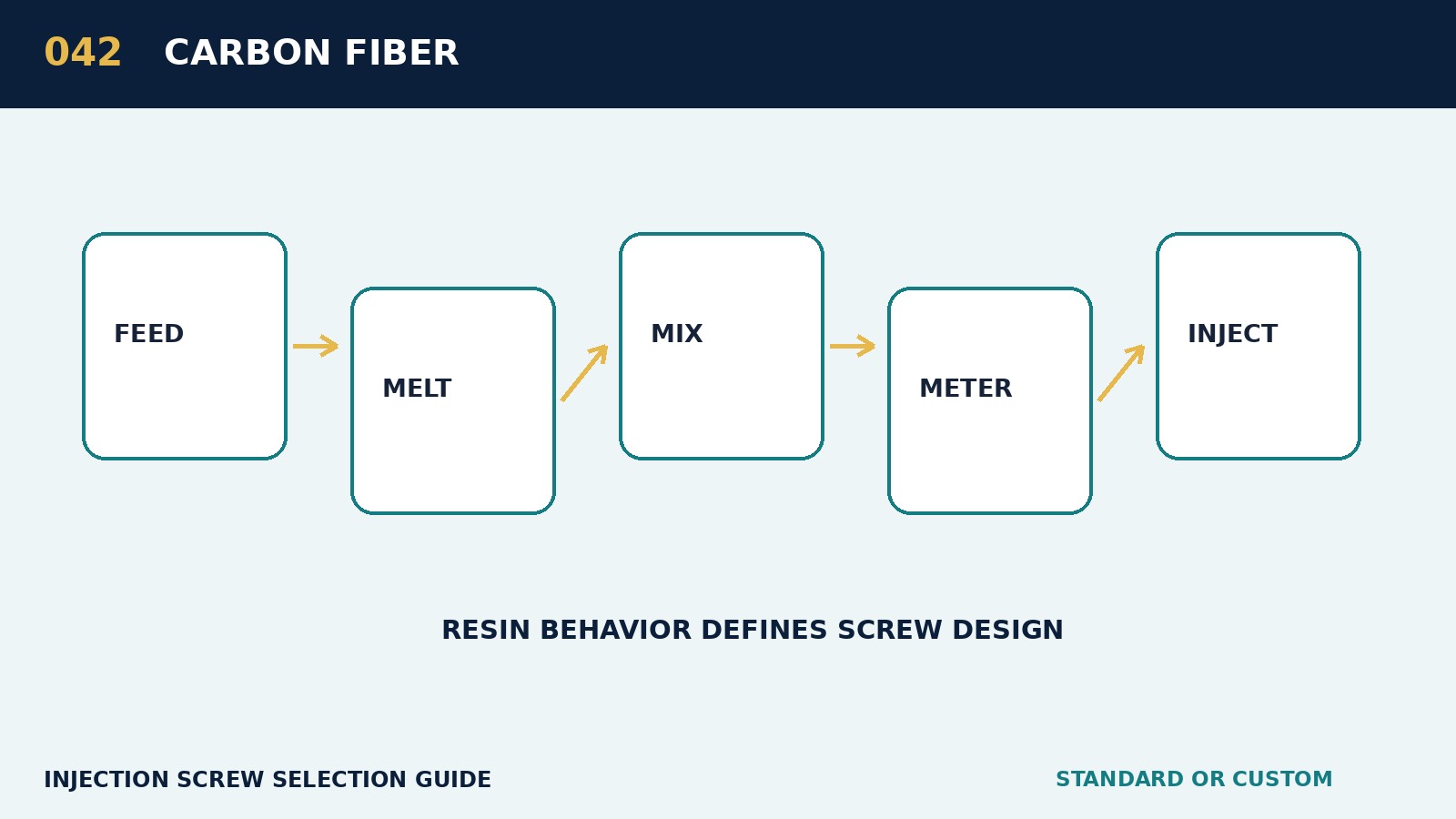
For carbon fibre complexes, customers often ask first for price or cut-off, but higher-end equipment sales teams should first check conductivity, erosion, fibre length and dispersion. Only by quantifying these conditions can the standard screws have an interpretable boundary with the choice of a dedicated screw.
Additions and fillings change the demand for currents, frictions, wear, corrosion and mixing. The configuration is not limited to additions, but also focuses on particle form, carrier, fibre length, decomposition products and batch fluctuations; where necessary, the screws, drums, retroring, nozzles and dry delivery systems are evaluated together. Material analysis cannot remain under PPP, ABS or PA names. The specific plate number, the percentage of the product or mineral filling, the flame-retarding system, the water-bearing requirements, the permitted stay time and the recommended processing temperature should be checked. Differences in the sensitivity of viscosity, wear, corrosiveness and shearing may be apparent in the broad categories of the same material, which change the compression ratio, the three-part ratio, alloy and surface treatment.
Technical communication distinguishes between three types of objectives that must be met, desired improvement and acceptable. It is necessary to meet the hard boundary of the item for the determination of equipment and screws, and it is hoped that the improvement item will be used for the comparison of standards and specialized programmes, while the acceptable item will help to control costs and deadlines. This would avoid stacking all requirements on a screw and would make it easier for clients to understand the real value of each configuration. The focus of discussion in this paper is on conductivity, erosion, fibre length and dispersion, which must correspond to the customer ' s current production conditions and cannot be based solely on the maximum values in machine samples.
In the context of this project, it is proposed to adopt the idea of “resilient structures coupled with moderate and condensed design”. First, to determine whether the available data support the choice, then to calculate the volume of reductive, pressure and plasticization, and finally to discuss the geometry, front-end components and material handling of the screws. If the standard formula is able to cover the window, priority should be given to the standard configuration; the risk of loss of fibre and change of performance if overcuted remains, with a dedicated structure presented and the increased costs, delivery periods and expected benefits indicated.
Special vigilance is needed to overcut fibres and change performance. Many of the post-sale disputes arise from inconsistencies between the design input and the actual production conditions, such as the customer ' s replacement of the raw material number, the increase in the return rate or the transfer of the screw to another set of moulds, while still requiring the maintenance of the original acceptance results. The configuration of the boundary and change management should therefore be included in the technical document.
Validation focuses on fibre retention, conductivity and mechanical performance. The test shall use the actual material and representative moulds of the client, retaining the batch number, dry condition, ambient temperature and sample number. When compared to old schemes, equipment, moulds and major process conditions other than screws should be as consistent as possible. With the continued accumulation of project data on carbon fibre composites, the equipment manufacturer could gradually establish a package, a trade package and an aircraft-type menu to allow sales to quickly identify general and special conditions, while at the same time placing a truly complex project in a timely manner for evaluation by an application engineer.