
Why is POM production controlling shearing and material stopping?
Release time:2026-09-22
For the seller of precision equipment, describe the method of checking heat stabilization windows, friction heat, dead angles and cut-off materials, analyse the risk of local overheating resulting in decomposition and security risks, and give recommendations for validation of the use of lower shears, low-suspension structures and the regulation of shut-off procedures and temperature, odor abnormalities and appearance stability.
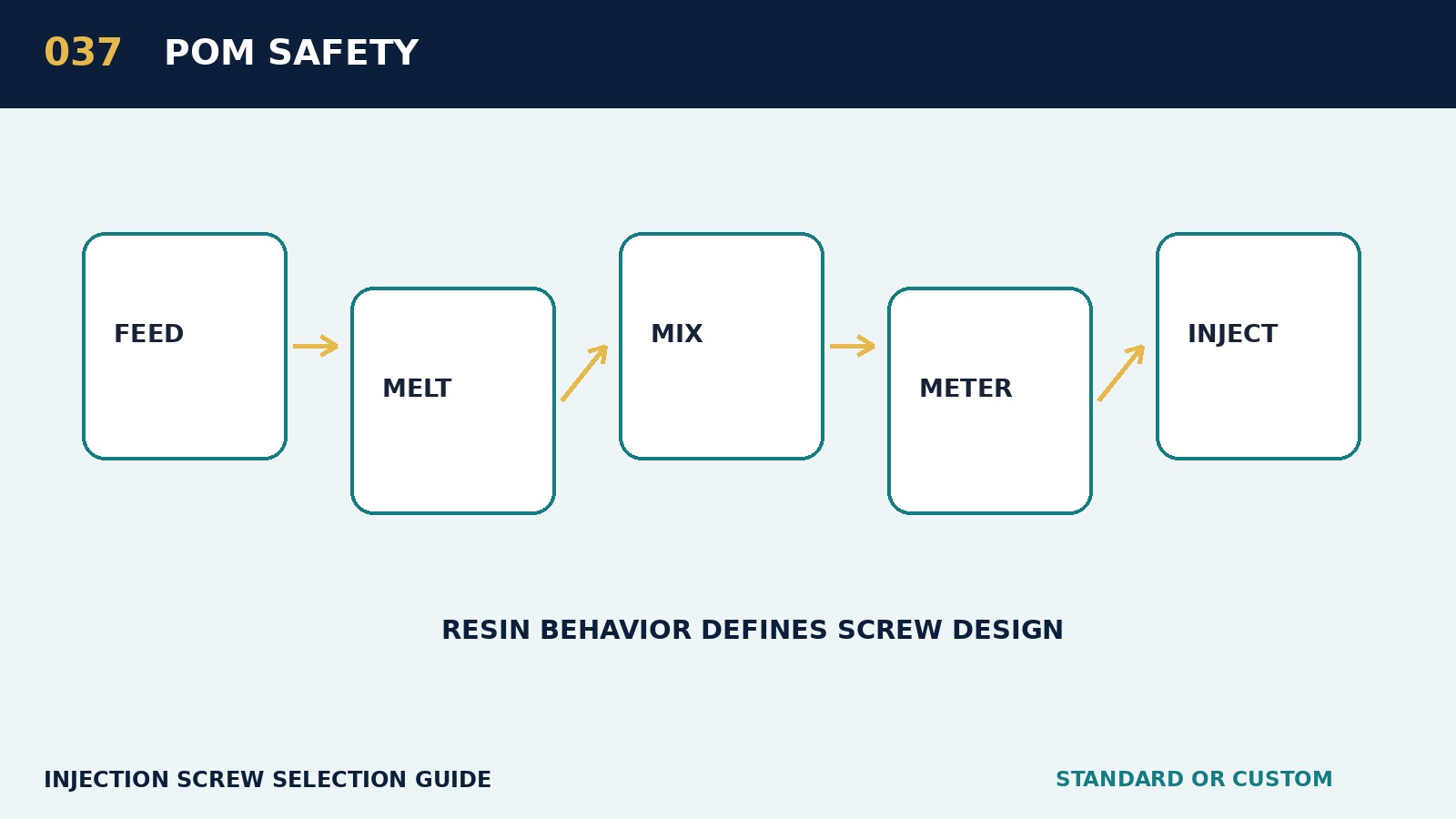
In response to POM formation, customers often ask first for price or term, but the seller of precision equipment should first check the heat-stabilizing window, friction heat, dead-angle and stop-off. Only by quantifying these conditions can the standard screws have an interpretable boundary with the choice of a dedicated screw.
The name of the raw material can only be classified as the first layer, and what really determines the screw configuration is the viscosity, melting point, thermal stability, humidity, filling and additive of the specific plate. Vendors should obtain material forms and identify whether the customer uses raw, retroactive or retroactive formulations to discuss generic, grinding, corrosive or lower shear structures. Calculates the nominal value to be converted to the actual condition. The machine often uses PS as a reference for the gel weight, which should be revised by density when using other raw materials; the weight of the product should be added to the main course, traffic separation and a reasonable buffer. The larger the diameter of the screw, the greater the theoretical capacity, but the pressure of injections per unit area under the same hydraulic pressure or servo system will decline and the resolution of the measurement of the small amount of the aerosol may also be variable.
Material analysis cannot remain under PPP, ABS or PA names. The specific plate number, the percentage of the product or mineral filling, the flame-retarding system, the water-bearing requirements, the permitted stay time and the recommended processing temperature should be checked. Differences in the sensitivity of viscosity, wear, corrosiveness and shearing may be apparent in the broad categories of the same material, which change the compression ratio, the three-part ratio, alloy and surface treatment. The focus of discussion in this paper is on heat stabilization windows, friction heat, arctics and stopovers, which must correspond to the customer ' s current production conditions and not be limited to the maximum values in machine samples.
From a sales management point of view, the use of low-cut, low-suspension structures and the regulation of shut-down procedures should constitute a standard process that can be used again. Each project saves original needs, computations, final drawings, test modelling data and client feedback, and can call on experience in the event of a similar machine or material, but there is still a need to reconcile key differences and not to copy the historical configuration directly.
If the above steps are ignored, the most common consequence is that local overheating poses decomposition and safety risks. The problems are often manifested in the trial phase of measuring time instability, insufficient stress residuals, buffer drift, unmelted, black spots, colour differentials or increased wear and tear. Continued increase in temperature, back pressure and turn speed at this time may temporarily improve the appearance, but may increase the shearing heat, material degradation and equipment load.
It is recommended that clients set clear upper and lower limits around temperature, odour anomalies and appearance stability, rather than simply "functioning properly". Quantification criteria may include measurement of time fluctuations, extremely poor product weights, number of black dots, change time, hourly production or ton wear and tear, with specific projects choosing indicators that really affect business outcomes. Where the information is temporarily incomplete, the pre-selection scope and the list to be confirmed may be provided, but it should not be considered a final commitment. The freeze of the configuration after the customer has completed the heat-stabilization window, friction heat, dead-angle and stop-of-air clean-up can reduce erroneous orders and facilitate the production, testing, installation and sale of the same version of data.