
The cause of the unmelted particles and the uneven plastic spiral
Release time:2026-10-02
For end-of-pipe aggregation plants, review the causes of unmelted particles and the uneven plasticization of the screws, combining product, raw material, platform, production, life cycle and life-cycle data to reduce the cost of scrap, shutdown and life-cycle.
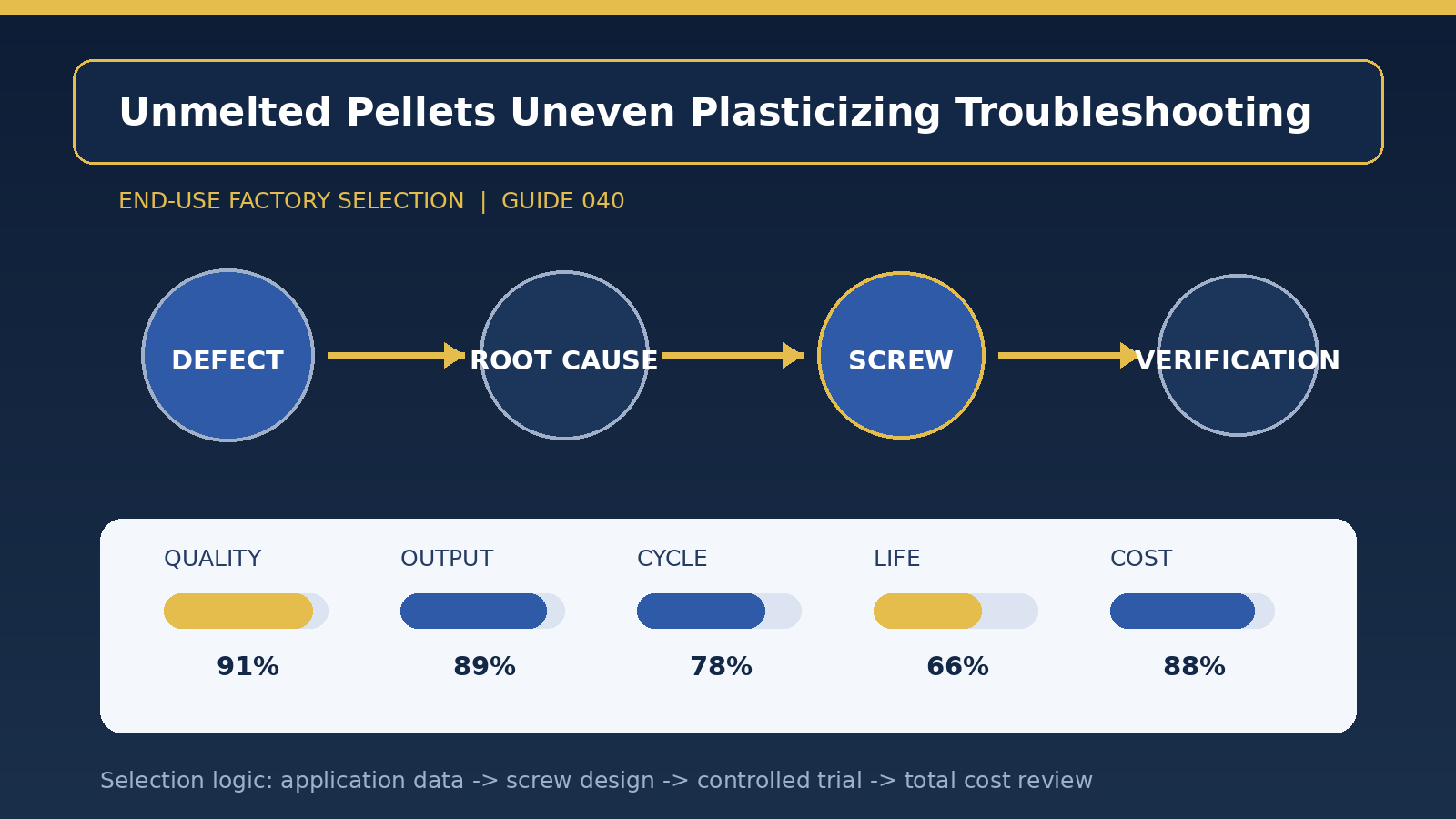
[Scene definition] The reason for the unmelted particles and plasticized uneven screws is to start from the actual production scene of the plant and not just the diameter or price of the screw. It is recommended that the frequency of defects, time periods and changes in process parameters be first collated and then that a uniform sampling method be used for the same product on different platforms to facilitate horizontal comparisons. The aim of this step is to establish comparable old programme benchmarks so that subsequent screw changes can be supported by data.
The most easy to ignore on this topic is the boundaries of screws, cylinders, reversible rings and molds. The plant shall break down the daily production into class beats, time available and model exchange losses, and bind the planned lifetime to the annual operating hours, feedstock type and frequency of maintenance. Vendors can make retroactive trade-offs between interoperability, earmarking and cost when there are clear values for product weight, daily production, customer quality caps and allowed stop times.
The main line of the case [design focus] is to pre-empt the causes of drying, temperature control and molds with evidence. In geometric and material programmes, the measurement segment should be synchronized with the required back pressure to compensate for geometric deficiencies without excessive back pressure; and the measurement segment should be synchronized with the required back pressure to compensate for geometric deficiencies without excessive back pressure. The final solution would also need to be compatible with the wear and tear of the cylinder, the drive, the physical velocity and the current cleaning process, and would not cover up co-operation or process problems with a single high-level material.
The new [comparison-valid] programme proposes to operate for at least eight consecutive hours, extracting 20 sims for each stabilization phase, recording extremely poor single modulus weight, storage time and bad black spot rates. The test shall measure both the temperature of the entropy and the temperature shown in the drums, confirm the contribution of the shearing heat and maintain sufficient time at the normal upper load to observe the twist, temperature and measure drift. If only the first one is checked, it is easy to miss the risks associated with heat drifting, material stoppage, reversal loop return and prolonged wear and tear.
When the [stabilized production] spiral is shaped, trend maps should be created for the plume, the reverse ring gap and the inside of the cylinder, and inspection cycles should be developed for both running hours and tons of processed raw materials. The time of storage, back pressure, screw velocity, noise and mass of the product shall be recorded in a uniform manner in the shift. When the above indicators change at the same time, the mechanical gaps and the state of the raw materials should be checked before the process is adjusted to avoid the use of parameters to compensate for hardware degradation.
The [comprehensive cost] cost statement cannot simply be a screw price, and the cost of passenger litigation, return of goods, and additional overhaul should be classified as loss of quality, not only as scrap by aircraft, but also as loss of quality by passenger litigation, return of goods and additional overhauls, not just as waste by aircraft. It is recommended that the cost per 10,000 eligible items be exported simultaneously, the cost per 1,000 operating hours and the estimated number of return months. When new programmes reduce waste, refuelling or sudden shutdowns, higher initial inputs are often offset during production.
The [Closed Ring Management] will eventually include drawing numbers, screwdriver materials, heat treatment, critical dimensions, portable tubes, process windows and acceptance data in the curriculum vitae cards. It is proposed to establish a record of refuelling weights, cleaning time and first eligible time, while preparing screw-head components or spare parts for key platforms, and to review their availability on a regular basis. When there is a significant change in the feedstock formulation, retrospection ratio, product structure or target node, the applicable boundary of “unmelted particles and the causes of plasticized uneven screws” should be reassessed, rather than defaulting on the old conclusion being permanently valid.
Topic: Quality diagnosis and selection