
A plastic screw selection method targeting unit energy consumption
Release time:2026-10-02
(c) For end-of-pipe aggregation plants, to explain the retrofit selection method for unit energy consumption, combining product, raw material, platform, production, life-cycle and life-cycle data to reduce waste, shutdown and life-cycle costs.
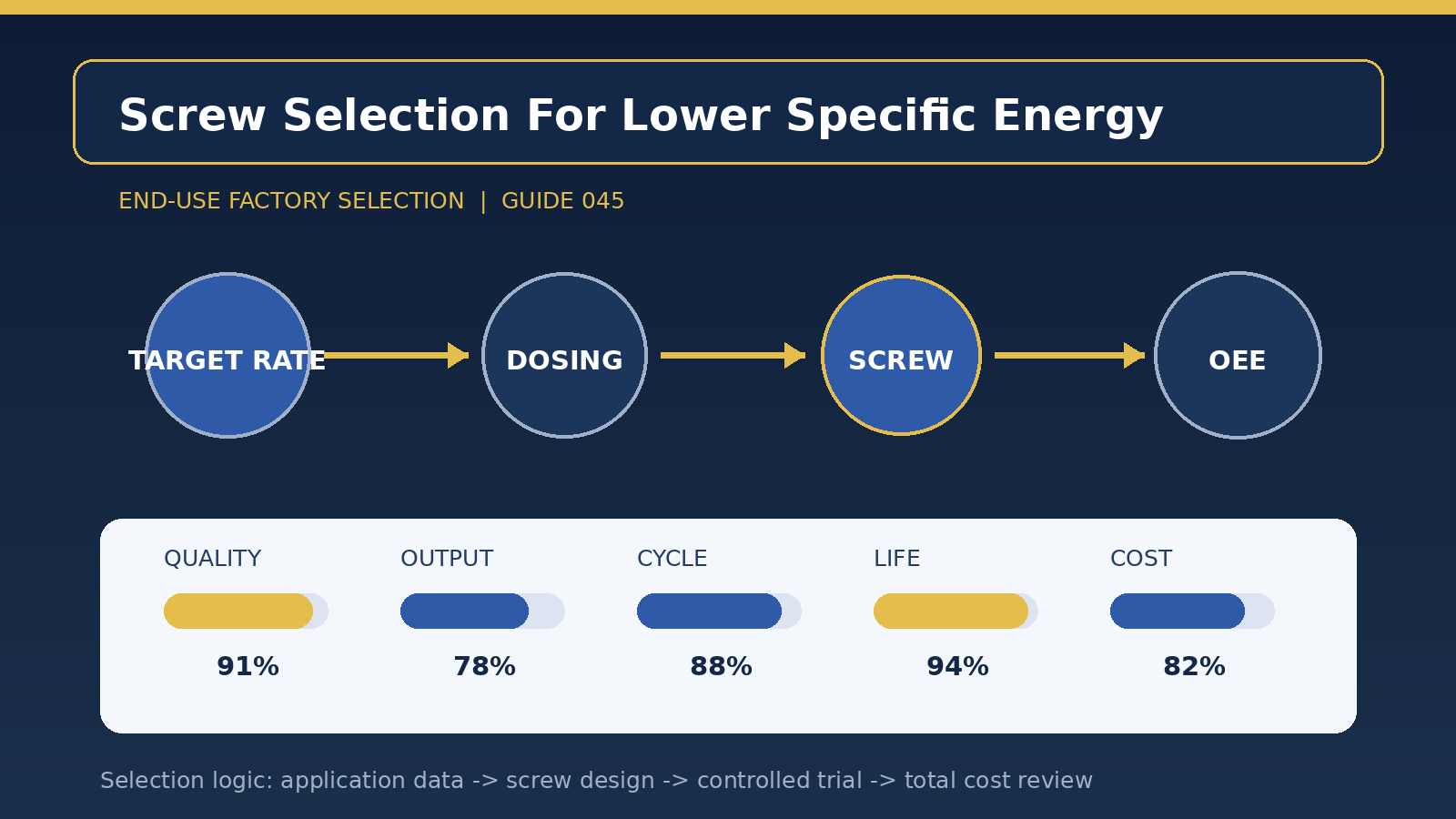
[Scene definition] The retrospective spiral-type approach, which aims at unit energy consumption, starts from the actual production scene of the plant and cannot be based solely on the diameter of the screw or the price. It is recommended that the target beats, storage time, refuelling frequency and OEE be first organized, and that early warning limits be set for the thermozones and driver loads of the cylinders, rather than just averages. The aim of this step is to establish comparable old programme benchmarks so that subsequent screw changes can be supported by data.
The easiest to ignore is plasticization, cyclical bottlenecks and long-cycle drift. Plants should place red lines of quality and equipment loads at the same time as key products and divide needs such as appearance, size, strength and odor into mandatory and optimized items. Vendors can make retroactive trade-offs between interoperability, earmarking and cost when there are clear values for product weight, daily production, customer quality caps and allowed stop times.
The main line in this case [design focus] is defined by a stable output rather than a short-term maximum speed. In geometry and materials programmes, the reverse ring structure and back-flow gap should be assessed on the basis of material fluctuations and injection pressure; and the inner and worn state of the cylinders should be integrated into the co-ordinated gap to avoid new screws being dragged by old cylinders. The final solution would also need to be compatible with the wear and tear of the cylinder, the drive, the physical velocity and the current cleaning process, and would not cover up co-operation or process problems with a single high-level material.
The new [comparison-valid] programme proposes to operate for at least eight consecutive hours, extracting 20 sims for each stabilization phase, recording extremely poor single modulus weight, storage time and bad black spot rates. Tests should be conducted immediately after the test, with acoustics, friction marks and metal powders to identify co-exist risks in a timely manner, as well as a planned refuelling test to check residues, black spots and cleaning material consumption. If only the first one is checked, it is easy to miss the risks associated with heat drifting, material stoppage, reversal loop return and prolonged wear and tear.
When the [stabilized production] spiral is shaped, cold-activated thermostats should be set at a temperature-preserving time and allowed to twist, to avoid cold-temperature forced storage and to combine cleaning, measuring, photographing and sampling in shut-off windows to reduce double-down. The time of storage, back pressure, screw velocity, noise and mass of the product shall be recorded in a uniform manner in the shift. When the above indicators change at the same time, the mechanical gaps and the state of the raw materials should be checked before the process is adjusted to avoid the use of parameters to compensate for hardware degradation.
The [integrated cost] cost statement should not simply be a spiral price, and procurement prices should be annualized on the basis of the expected useful life to prevent the frequent replacement of low-priced programmes to raise costs, and the single-unit energy consumption should be analysed in conjunction with storage time to avoid looking only at the total of the meter and ignoring output differences. It is recommended that the cost per 10,000 eligible items be exported simultaneously, the cost per 1,000 operating hours and the estimated number of return months. When new programmes reduce waste, refuelling or sudden shutdowns, higher initial inputs are often offset during production.
The [Closed Ring Management] will eventually include drawing numbers, screwdriver materials, heat treatment, critical dimensions, portable tubes, process windows and acceptance data in the curriculum vitae cards. It is recommended that three consecutive shifts be followed to avoid single-testing models representing the production status, and that the maximum number of repairs be set for each drop and surface thickness recorded for the refurbishment. When there are significant changes in feedstock formulations, retrospective ratios, product structure or target nodes, the applicable boundary of the “plastic screw selection method for unit energy consumption” should be reassessed rather than defaulting on the permanent validity of the old conclusion.
Title of article: Guidelines for the selection of a plastic plant for end-notes