
Why do heat-sensitized materials need a low-cut special screw?
Release time:2026-09-22
For PVCs and biomaterial equipment manufacturers, describe the method of checking decomposition temperatures, stopovers, friction heat and arctics, analyse the risk of local shearings that cannot be eliminated by cooling, and provide recommendations for the validation of optimized compression, stream and front-end low-suspension structures and material temperature, decomposition and appearance.
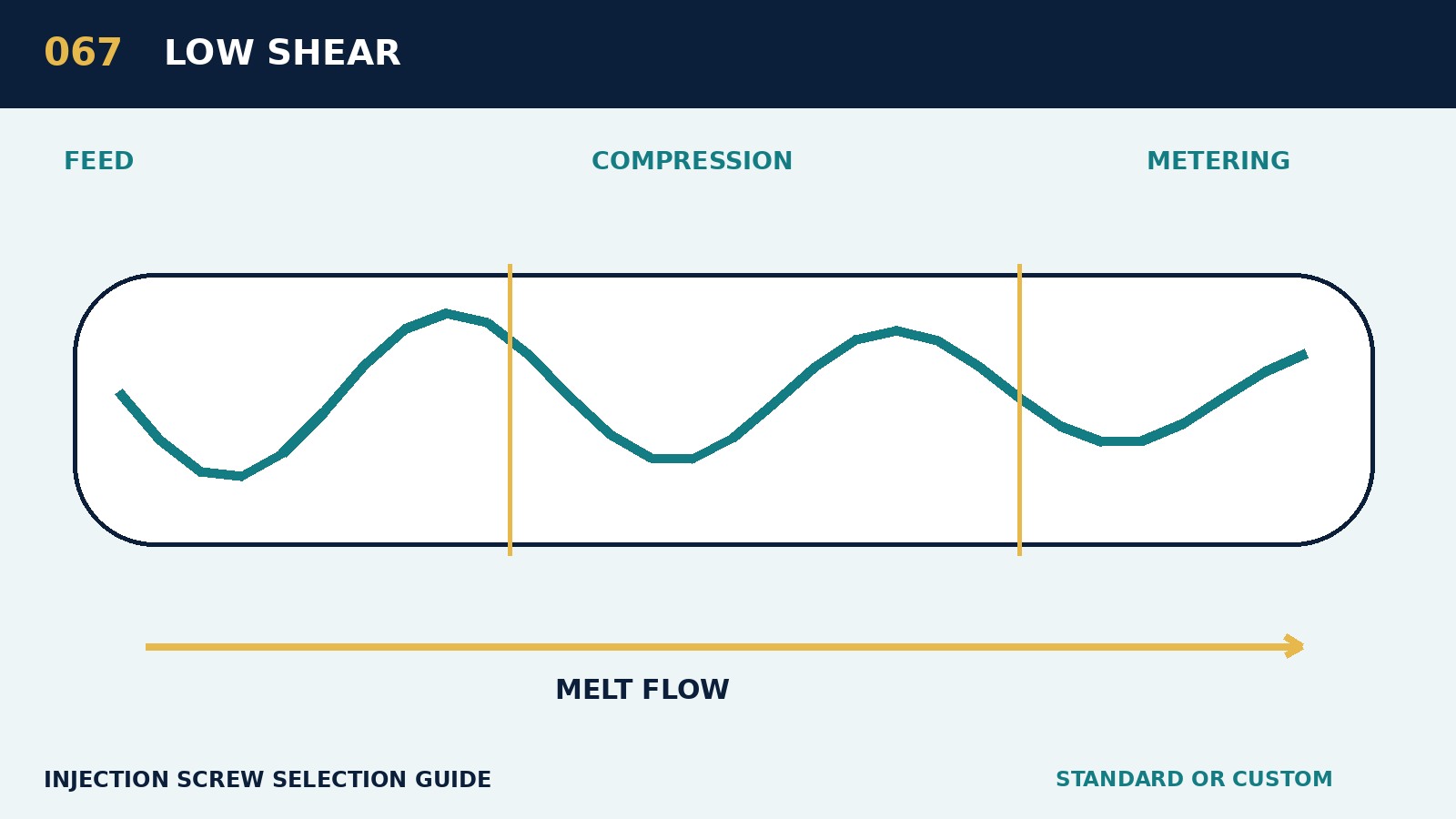
In the case of low-cutting plasticization, customers often ask for price or cut-off, but PVC and biomaterial equipment manufacturers should check the decomposition temperature, stopover, friction heat and dead end. Only by quantifying these conditions can the standard screws have an interpretable boundary with the choice of a dedicated screw.
It's not absolutely good or bad. Standard schemes are appropriate for simple work, wide material windows and priority projects; the value of a dedicated structure is clear when materials are corrosive, corrosive, hot, sensitious or production requirements exceed the generic boundary. The judgement must be based on data and failure patterns. Material analysis cannot remain under PPP, ABS or PA names. The specific plate number, the percentage of the product or mineral filling, the flame-retarding system, the water-bearing requirements, the permitted stay time and the recommended processing temperature should be checked. Differences in the sensitivity of viscosity, wear, corrosiveness and shearing may be apparent in the broad categories of the same material, which change the compression ratio, the three-part ratio, alloy and surface treatment.
Technical communication distinguishes between three types of objectives that must be met, desired improvement and acceptable. It is necessary to meet the hard boundary of the item for the determination of equipment and screws, and it is hoped that the improvement item will be used for the comparison of standards and specialized programmes, while the acceptable item will help to control costs and deadlines. This would avoid stacking all requirements on a screw and would make it easier for clients to understand the real value of each configuration. The focus of discussion in this paper is on decomposition temperature, stopover, friction heat and arctic angles, which must correspond to the customer ' s current production conditions and not be limited to the maximum values in machine samples.
The configuration proposal should be oriented to optimize compression, fluids and front-end low retention structures rather than using vague descriptions such as “enhanced” or “high performance”. The spiral drawings need to reflect the effective length, three-part scale, depth, compression ratio, tail connection and anti-reverse components; the material programme needs to distinguish the base, surface hardening, alloy layer or coating, and to indicate the pattern of failure for which they are intended.
The main risk of the scene is that the local shearing cannot be eliminated by cooling. The issue of whether or not to be derived from a screw should first be excluded from drying, heating ring, thermal voltage, nozzles, reversible rings, wear and tearing of the material drums and changes in process parameters. The use of exclusions is more reliable than the direct replacement of components and also protects the time and cost of both the seller and the client.
Upon completion of the project, the delivery conclusions are based on temperature, decomposition and appearance, and the size tests, material or heat treatment certificates, trial modelling records and maintenance recommendations are archived. Sales teams can return after three months or a ton agreement to compare plasticization time, energy consumption, product fluctuations and wear and tear trends. Therefore, a simple logic of “symmetrically-sized screw” should not be used for low-cut cutting. Only by accounting for products, feedstocks, tonnages, voltage, screw diameter and target cycles will the standard screws have a clear scope of application and the dedicated screws have a reasonable design basis and return on investment.