
The compression ratio should be based on the material or the product.
Release time:2026-09-22
For application engineers, describe the means of checking material volume changes, exhausting, cutting, and product quality, analyse the risks of overheating as a result of overcompression, or insufficiently melting at too low a level, and give recommendations for verification of non-melted particles, temperature and rectification stability based on the material properties and the product requirements.
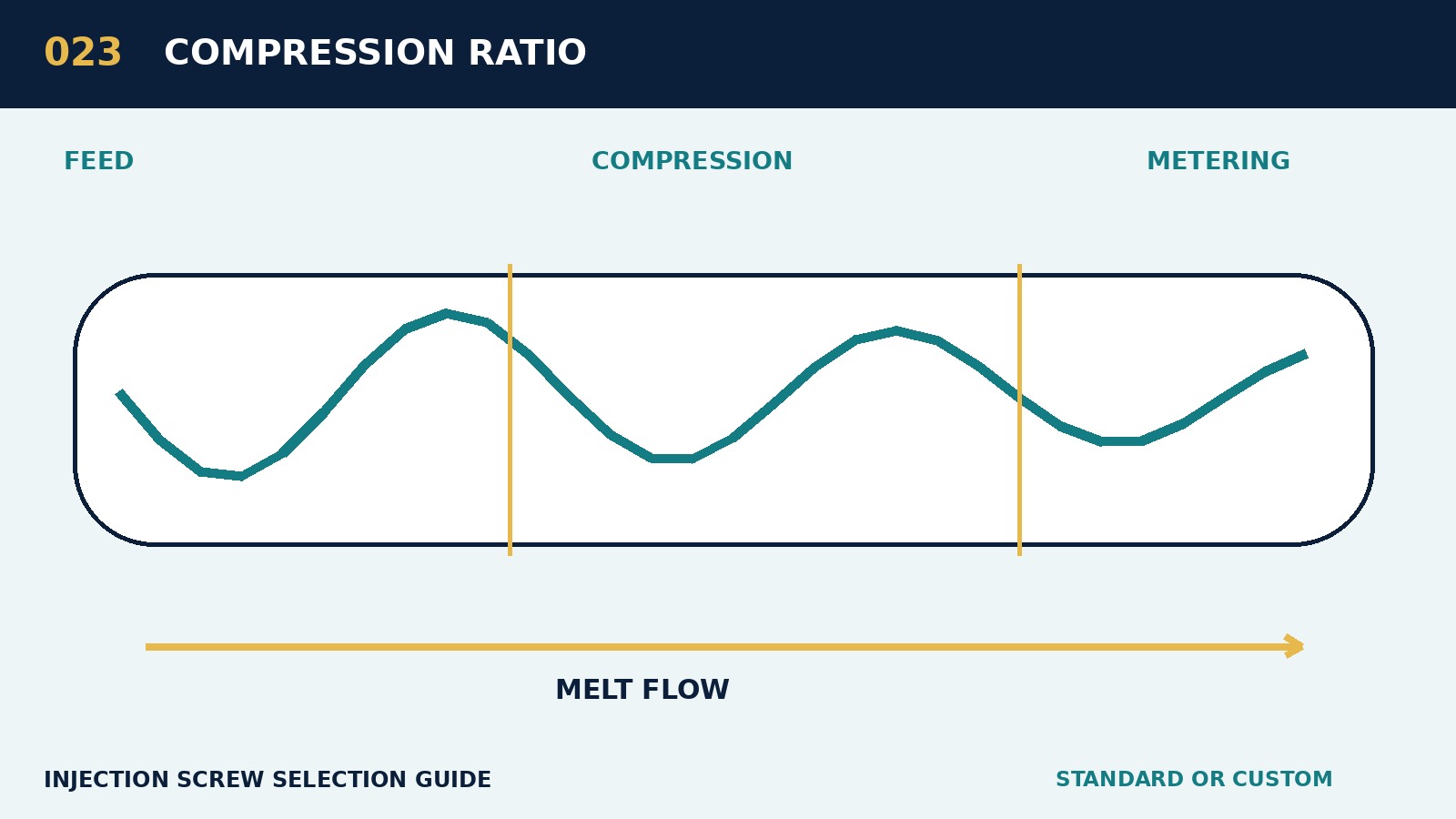
The compression ratio selects what appears to be a conventional device selection and is, in practice, prone to deviations due to changes in material size, exhaust, cut-off and product quality not being assessed at the same time. For application engineers, the correct approach would be to establish a baseline of conditions before discussing specific configurations.
Each size of the screw structure serves solid transport, melting, refining, measuring and injection sealing. The diameter, long-range ratio, three-part ratio, depth, compression ratio and front-end components need to be considered as a system; local parameters appear to be stronger and do not represent the raw materials and cycles of the package that are more suitable for customers. Technical communication distinguishes between three types of objectives that must be met, desired improvement and acceptable. It is necessary to meet the hard boundary of the item for the determination of equipment and screws, and it is hoped that the improvement item will be used for the comparison of standards and specialized programmes, while the acceptable item will help to control costs and deadlines. This would avoid stacking all requirements on a screw and would make it easier for clients to understand the real value of each configuration.
Material analysis cannot remain under PPP, ABS or PA names. The specific plate number, the percentage of the product or mineral filling, the flame-retarding system, the water-bearing requirements, the permitted stay time and the recommended processing temperature should be checked. Differences in the sensitivity of viscosity, wear, corrosiveness and shearing may be apparent in the broad categories of the same material, which change the compression ratio, the three-part ratio, alloy and surface treatment. The focus of discussion in this paper is on material volume changes, exhausts, shears and product quality, which must correspond to the customer ' s current production conditions and not be limited to the maximum values in machine samples.
From a sales management point of view, modifications based on feedstock characteristics and product requirements should constitute a standard process that can be used again. Each project saves original needs, computations, final drawings, test modelling data and client feedback, and can call on experience in the event of a similar machine or material, but there is still a need to reconcile key differences and not to copy the historical configuration directly.
If the billing is done quickly, on the basis of experience, overheat is caused by over-compression, and under-melting is likely to occur after delivery. The success of a single test module does not represent long-term stability, particularly for projects with high filling, high temperature, frequent colour change or multi-molecular co-plasms, and needs to look at changes in batches of material, the length of continuous production and the accumulation of wear and tear.
Ultimately, the programme should be judged by unmelted particles, temperature and recoil stability. If the result fails to meet the standard, each adjustment and result shall be recorded in five directions, by raw material, equipment, molds, process and screw, so as to avoid the loss of causal judgement by modifying multiple parameters at the same time. The sales proposal should answer three questions at the same time: why this selection was made, which conditions had changed and which were re-selected, and how the customer validated the results. Clearing these three questions would make it possible to move from a trade in spare parts to a retroactivity technology project.