
How does the ABS look less black and yellow and silver?
Release time:2026-09-22
Sales teams for domestic electric appliances describe the method of checking the requirements for drying, stopping, cutting, rectangular and color change, analyse the risk that high shears or demurrages will magnify the appearance defects, and provide recommendations for the verification of the use of free-flow and moderate cut-off special configurations and the number of black spots, colour differences and machine time.
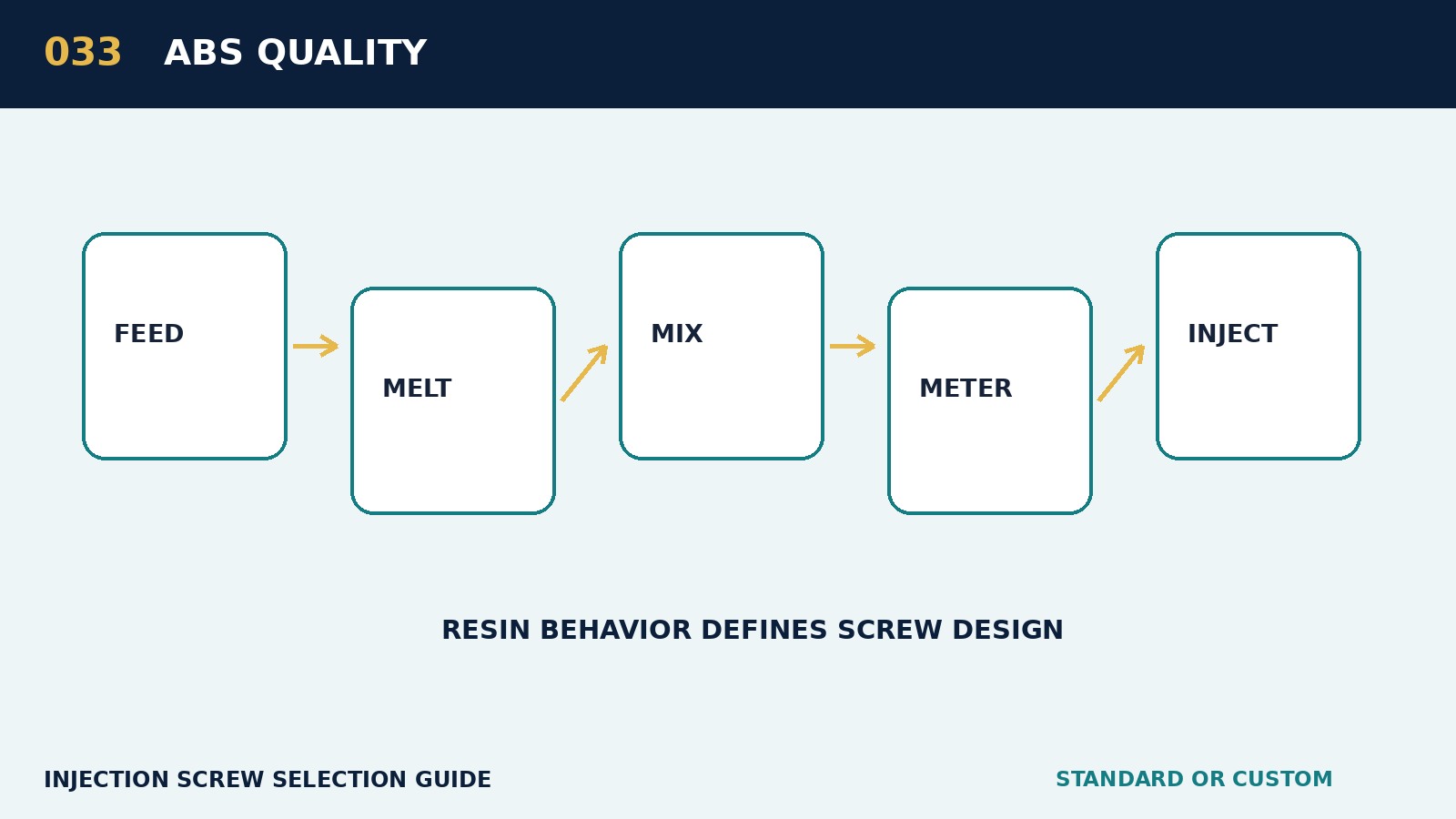
The ABS appearance appears to be a conventional device selection, which is more likely to deviate from the fact that drying, stopping, cutting, rectangular and color-changing requirements are not assessed simultaneously. The right approach for the power distribution team is to establish a baseline of the conditions before discussing the specific configuration.
The name of the raw material can only be classified as the first layer, and what really determines the screw configuration is the viscosity, melting point, thermal stability, humidity, filling and additive of the specific plate. Vendors should obtain material forms and identify whether the customer uses raw, retroactive or retroactive formulations to discuss generic, grinding, corrosive or lower shear structures. Site information should preferably include both photographs, short videos and data sheets. Photos are used to identify machine interfaces, screw tails and front-end components, video can be observed to measure, buffer and abnormal sound, and data tables are used to calculate the rate of application, the need for plasticization per hour and the length of stay. If only partial information can be obtained, a list should be provided for confirmation, rather than a tentative condition being a definitive conclusion.
Technical communication distinguishes between three types of objectives that must be met, desired improvement and acceptable. It is necessary to meet the hard boundary of the item for the determination of equipment and screws, and it is hoped that the improvement item will be used for the comparison of standards and specialized programmes, while the acceptable item will help to control costs and deadlines. This would avoid stacking all requirements on a screw and would make it easier for clients to understand the real value of each configuration. The focus of the discussion here is on drying, stopping, cutting, cutting, rectangular and color-changing requirements, which must correspond to the customer ' s current production conditions and not be limited to the maximum values in machine samples.
The project may be advanced with a free-flow and cut-in-the-mode special configuration as the main line, with an evaluation of sales, design, process and customer participation. The evaluation focused on the completeness of the input data, whether the assumptions were confirmed by the client, whether the mechanical interfaces were matched, how standards and specialized programmes were selected, and who provided the acceptance data.
Special vigilance needs to be exercised that high shears or demurrages magnify physical defects. Many of the post-sale disputes arise from inconsistencies between the design input and the actual production conditions, such as the customer ' s replacement of the raw material number, the increase in the return rate or the transfer of the screw to another set of moulds, while still requiring the maintenance of the original acceptance results. The configuration of the boundary and change management should therefore be included in the technical document.
The focus of the validation was on black dot number, color differential and clearance time. The test shall use the actual material and representative moulds of the client, retaining the batch number, dry condition, ambient temperature and sample number. When compared to old schemes, equipment, moulds and major process conditions other than screws should be as consistent as possible. Therefore, the ABS appearance should not follow the simple logic of “same tonnage and screw”. Only by accounting for products, feedstocks, tonnages, voltage, screw diameter and target cycles will the standard screws have a clear scope of application and the dedicated screws have a reasonable design basis and return on investment.