
The structure of pineapple is the method of diversion and the scope of application
Release time:2026-09-20
The staggered groove on the pineapple head surface divides the smelting into multiple shares and changes repeatedly, focusing on distribution mixing and temperature homogenization. This is illustrated by working principles, selection conditions, common risks and certification methods The system of diversion and application of the radial blending structure helps the plating plant to stabilize plasticization and to reduce the full life cost of a screwdriver.
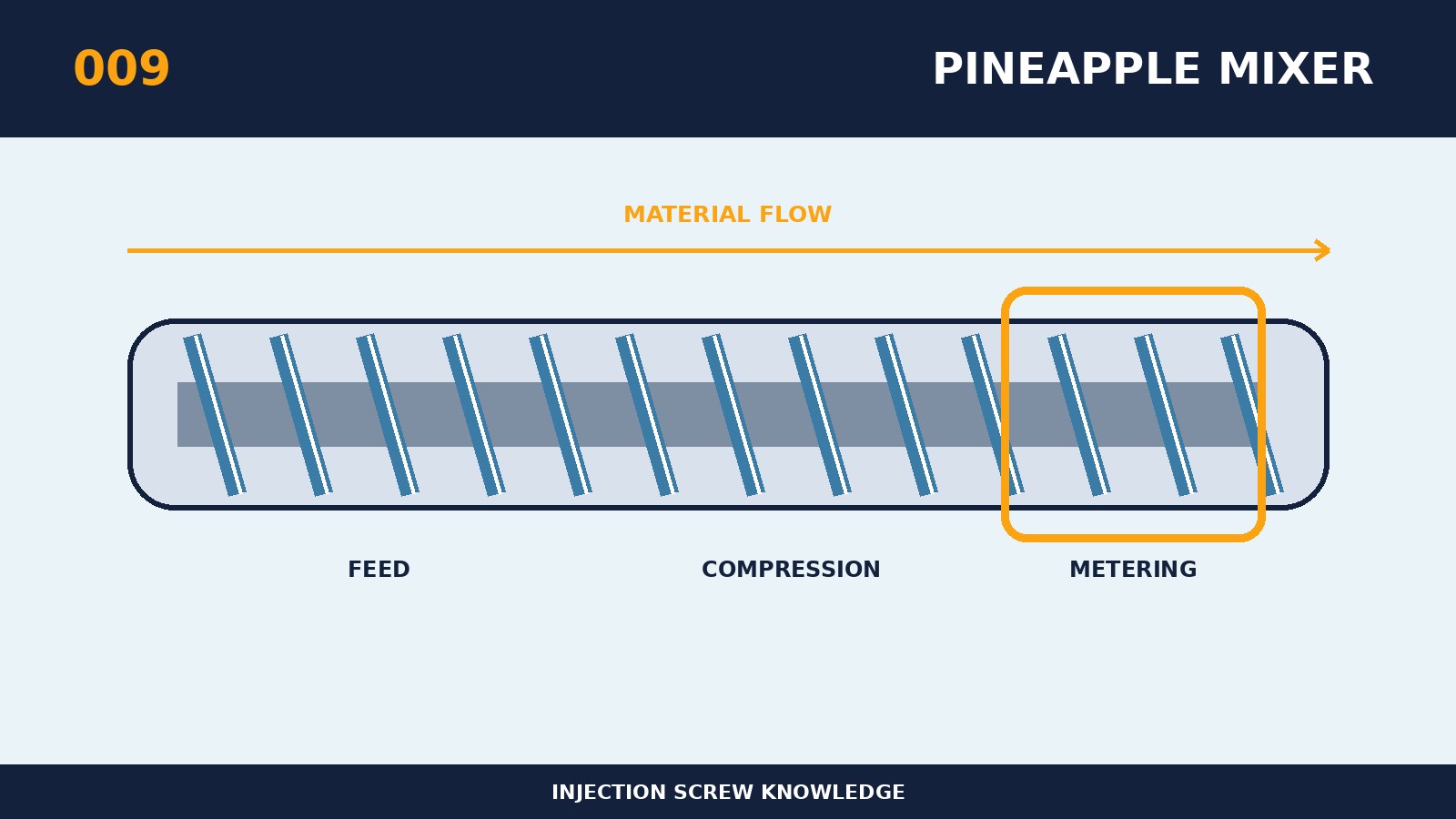
In order to match pineapple-mixing structures with their application, it is important not only to refer to old sizes or equipment labels, but also to understand the real changes in the materials in the snails. At its core is the staggered groove of pineapple head surfaces, which divides the melting into multiple units and shifts repeatedly, focusing on distribution mixing and temperature homogenization. The number of diversions and the loss of pressure are determined by the cross angle, depth and effective length of the grooves and cannot be regarded as having the same properties. Structural parameters are interconnected and any local modifications are evaluated in the complete path of transport, melting, mixing, metrology and cleaning. The selection programme should draw the boundary of production, temperature rise, twirl and time of stay before determining whether the parameter pushes the work to an uncontrolled area. Nominal specifications are therefore only the starting point, and the final conclusions must serve the actual resin, product and volume rhythm.
When customizing around "Strategic mechanisms and application of pineapple condensing structures", first collects the size of equipment models, original screws and material drums, driving capacity, resin number and filling system, single mass, cycle and existing defects. The specific selection principles for this topic are: material suitable for colour parity, temperature differential control and multi-assembly distribution requirements that are high and do not warrant strong fragmentation. The specimen shall keep the batch of raw materials, the baking conditions and the mold cooling, and shall determine the spiral reaction by measuring the time, peak twist and actual melting temperature. The technical agreement should include quantifiable provisions for size benchmarks, key communications, material status and acceptance methods so that new, old and subsequent restorations can be compared under the same criteria.
The most important defence against the failure of this subject is the ease of demurrage when the gutter has a tipping or insufficient polishing and the possibility of continuing to bring black dots and colour lines when light or transparent materials are replaced. Periodic fluctuations can be contrasted by the number of screws, the frequency of additions and the frequency of hydraulic pulses, with the characterization of the source. For on-site processing, only one main variable is changed each time and the measurement time, twist, melting temperature, mat, injection pressure and product weight are aligned to the same pattern. If production is to be sustained by excessive temperature, turn speed or back pressure, the use of parameters to mask structures, wear or collage should be discontinued.
This replicable approach can be used to verify the "schematic and application of pineapple-mixing structures" by comparing the colour change time, colour differential, smelting temperature horizontal differentials and stoppage checks to confirm that there are no hard-to-clean angles. The first data is stored as a baseline for the equipment, and each subsequent maintenance is based on the same material number, quantity and sampling method in order to be able to detect a drift. Inquiries to suppliers should also be accompanied by information on resins and fillings, risk of flame retardation or corrosion, total weight of products and fluids, photographs of available screws and equipment curves. The programme is considered to have a stable engineering value when the detection data, the good product rate, the timing of the switch and the unit cost of the eligible goods are improved.