
What's the impact of long-range ratio on the preservation rate of the fiber length?
Release time:2026-09-20
The number of clippings and the distance of stay experienced by the product in the screw affect the final length and orientation base. The working principles, selection conditions, common risks and certification methods explain the impact of long-range ratios on the retention rate of the pelican length, helping to stabilize the plasticization and reduce the full-life cost of the screws.
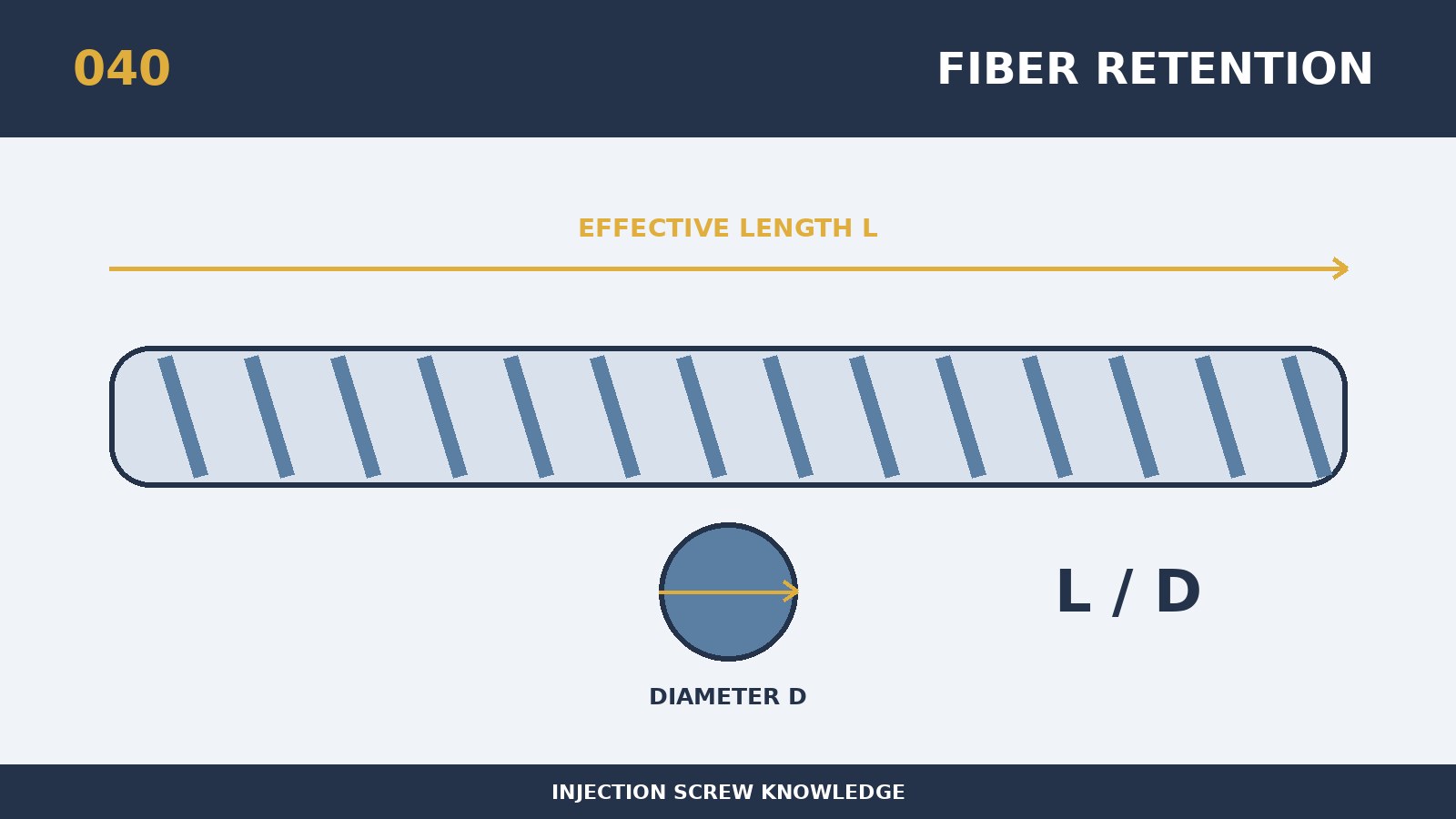
The impact of the long-range ratio on the preservation rate of the fibre length is directly related to plasticization quality and equipment loads, so design, procurement, switchboard and maintenance personnel should use the same set of evaluation criteria. At its core is the number and distance of cuttings experienced by the fibers in the screws that affect the final length and orientation base. Longer L/D can improve melting and distribution, but may allow fibres to experience more repeat cuttings. The long-range ratio is only a geometric entry, and what really determines is the effective length, distribution of the functional segments, actual production and material heat history. The design evaluation is to distinguish between “scales can be installed” and “processes can be stabilized”, the former only resolve mechanical interfaces, and the latter relate to plasticization efficiency and product quality. Nominal specifications are therefore only the starting point, and the final conclusions must serve the actual resin, product and volume rhythm.
When customizing around “What impact is the long-range ratio on the retention rate of the condensation length” the equipment model, the original screw and the material drum are first collected for measuring size, driving capacity, resin number and filling system, single mass, cycle and existing defects. The specific selection principle for the topic is that it should be balanced between consolidation and retention on the basis of the percentage of the product, its original length, product strength and surface requirements. The operational evaluation should not only look at single-modules, but at least cross three stages of complete warming, steady-state production and a moratorium on restarting. The technical agreement should include quantifiable provisions for size benchmarks, key communications, material status and acceptance methods so that new, old and subsequent restorations can be compared under the same criteria.
The most important defence against the failure of the subject is that blindly prolonging the screw or increasing the band will improve the appearance of the product but the mechanical performance will decline. Short-term increases in temperature or back pressure cover part of the structural problem but cannot be a long-term response if the twist, degradation or cycle deteriorates simultaneously. For on-site processing, only one main variable is changed each time and the measurement time, twist, melting temperature, mat, injection pressure and product weight are aligned to the same pattern. If production is to be sustained by excessive temperature, turn speed or back pressure, the use of parameters to mask structures, wear or collage should be discontinued.
This replicable option can be used to verify “how the long-range ratio affects the retention rate for the length of the fibers” by comparing the distribution of the length of the fibres with ashization or micromeasures, and simultaneously testing the stretching, impact and warp. If the programme involves new materials or layers, it can be scaled up in stages under controlled production, and the quality of wear and tear is reviewed at each stage. Inquiries to suppliers should also be accompanied by information on resins and fillings, risk of flame retardation or corrosion, total weight of products and fluids, photographs of available screws and equipment curves. The programme is considered to have a stable engineering value when the detection data, the good product rate, the timing of the switch and the unit cost of the eligible goods are improved.