
How to choose a screwhead and a converse ring under high pressure injection.
Release time:2026-10-02
For end-of-pipe aggregation plants, explain how, under high-voltage injections, screwheads and anti-reverse rings are selected, combining product, raw material, platform, production, life cycle and life-cycle data to reduce waste, downtime and life-cycle costs.
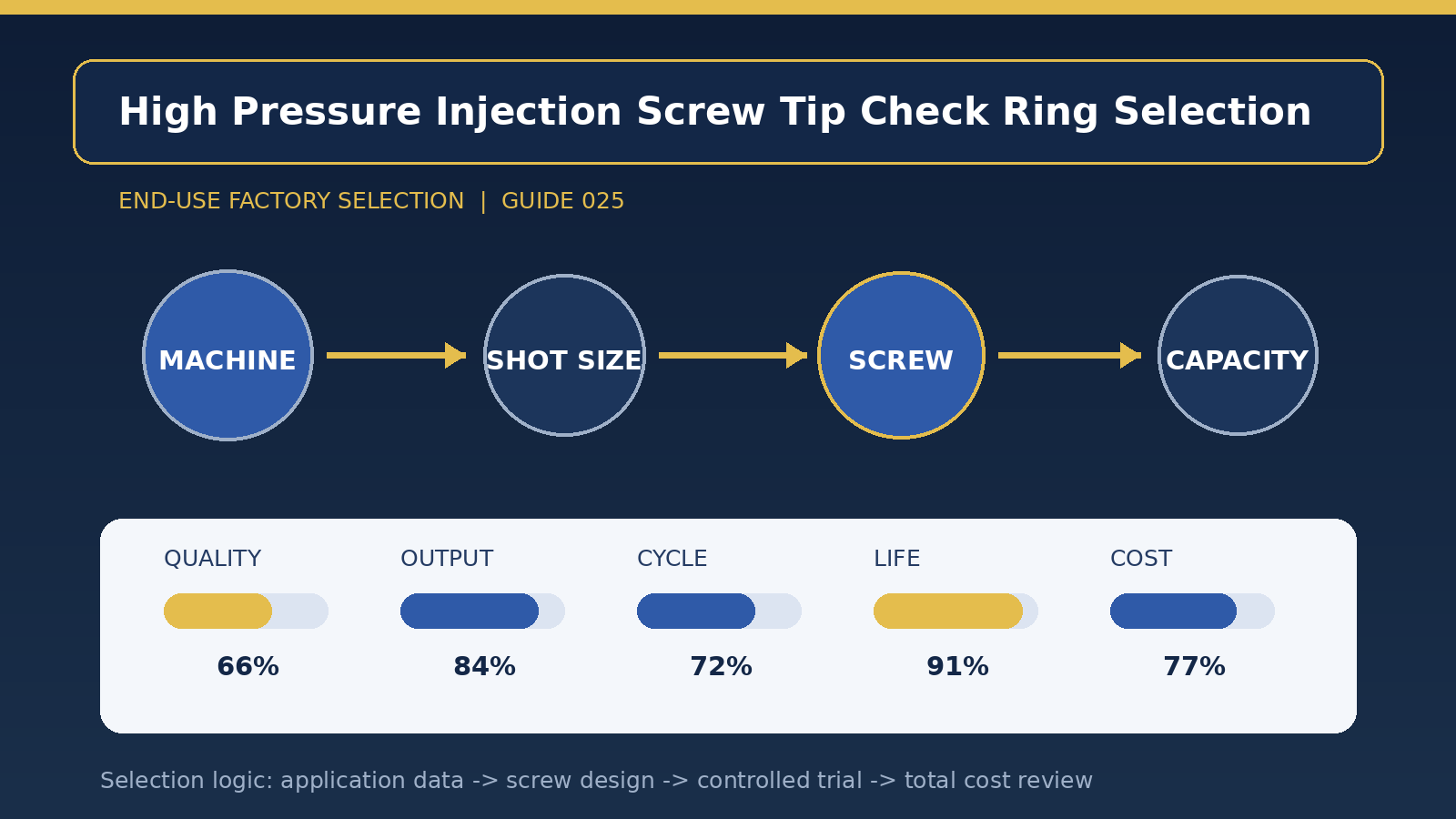
The choice of the screwhead and the reverse ring in the case of a high-pressure injection worker is based on the actual production scene of the plant and cannot be based solely on the diameter or price of the screw. It is proposed to first organize the amount of glue, screw diameter, itinerary, twist and maximum rotation, and then to set an early warning limit for the temperature and drive loads of the cylinders, instead of looking at averages only. The aim of this step is to establish comparable old programme benchmarks so that subsequent screw changes can be supported by data.
The most convenient thing to ignore is that the platform capacity matches the quantity of the product. Plants should write quality standards in quantum, sampling, upper and lower limits and determination rules, and quality standards in quantum, sampling, upper and lower limits and determination rules. Vendors can make retroactive trade-offs between interoperability, earmarking and cost when there are clear values for product weight, daily production, customer quality caps and allowed stop times.
[Design Focus] The main line in this case is to balance accuracy and capacity within the safe utilization factor. In geometric and material programmes, the retrofitting, reflowing and screwhead residual areas should be checked for color change and refuelling; and the rudders should be checked, speed-rotation allowed and screw cores allowed, at the same time, to prevent increased capacity at the expense of mechanical safety. The final solution would also need to be compatible with the wear and tear of the cylinder, the drive, the physical velocity and the current cleaning process, and would not cover up co-operation or process problems with a single high-level material.
The new [comparison-valid] programme proposes to operate for at least eight consecutive hours, extracting 20 sims for each stabilization phase, recording extremely poor single modulus weight, storage time and bad black spot rates. A planned refuelling test should be added to the test to examine residues, black spots and cleaning material consumption, and to compare the old and new programmes with the same batches of raw materials, molds and sampling rhythms. If only the first one is checked, it is easy to miss the risks associated with heat drifting, material stoppage, reversal loop return and prolonged wear and tear.
When the [stabilized production] spiral is shaped, a system of metallic alien separation and magnetic insulation should be established, and after the anomaly the prune damage should be checked, and records should be numbered with a single asset, associated drawings, repair, up and down. The time of storage, back pressure, screw velocity, noise and mass of the product shall be recorded in a uniform manner in the shift. When the above indicators change at the same time, the mechanical gaps and the state of the raw materials should be checked before the process is adjusted to avoid the use of parameters to compensate for hardware degradation.
The [integrated cost] cost table should not only be a screw price, but should be analysed in conjunction with the time of storage, so as to avoid looking only at the total amount of the meter and ignoring the difference in output, in addition to the analysis of the total amount of the item in conjunction with the time of storage, and avoid looking only at the total amount of the meter and ignoring the difference in output. It is recommended that the cost per 10,000 eligible items be exported simultaneously, the cost per 1,000 operating hours and the estimated number of return months. When new programmes reduce waste, refuelling or sudden shutdowns, higher initial inputs are often offset during production.
The [Closed Ring Management] will eventually include drawing numbers, screwdriver materials, heat treatment, critical dimensions, portable tubes, process windows and acceptance data in the curriculum vitae cards. It is proposed to establish a record of refuelling weights, cleaning time and first eligible time, while preparing screw-head components or spare parts for key platforms, and to review their availability on a regular basis. When there is a significant change in the feedstock formulation, the retrospective ratio, the product structure or the target node, the applicable boundary for “the selection of the screwhead and the reversible ring under the high-pressure injection process” should be reassessed, rather than defaulting that the old conclusion is permanent.
Title of article: A guide to the selection of a plastic factory at the end