
Scramble selection of flame retardants ' case: Reduce decomposition and corrosion
Release time:2026-10-02
For end-of-pipe retrofitting plants, talk about the screw selection of flame-retarding electrical casings: reduce decomposition and corrosion, combine product, feedstock, platform, production, life cycle and lifetime data, and reduce waste, shutdown and life-cycle costs.
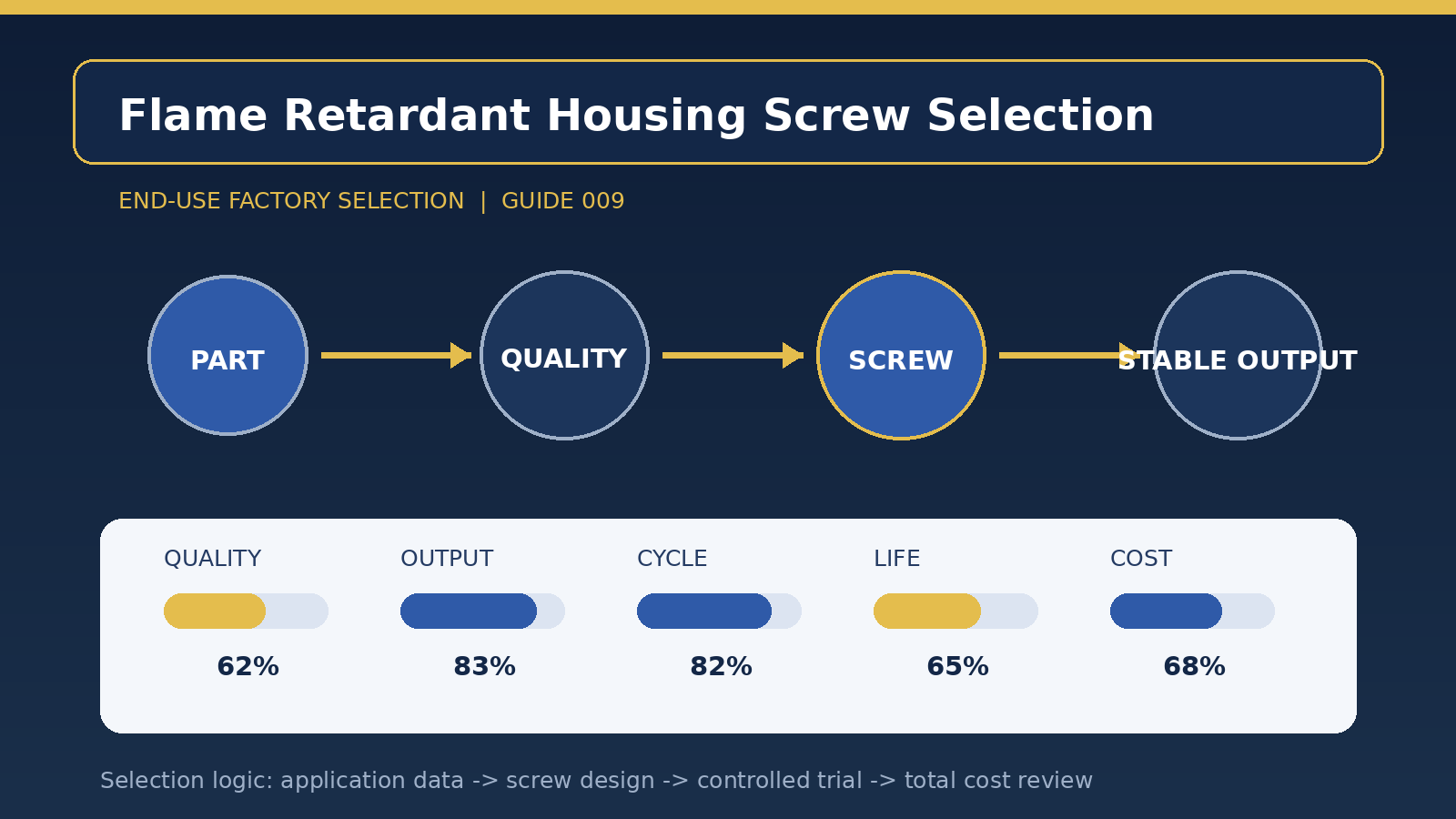
[Scene definition] Spoil selection for flame retarding electrical casings: Reduction of decomposition and corrosion is based on the actual production scene of the plant and cannot be based solely on the diameter of the screw or the price quoted. It is recommended that the product structure, appearance and size differences be first organized and then that benchmarks be established for each of the three phases of start-up, stable production and refuelling. The aim of this step is to establish comparable old programme benchmarks so that subsequent screw changes can be supported by data.
The most convenient thing to ignore is the stability of entropy and the repetition of injections. Plants should examine the remaining plasticization capacity on the basis of order peaks rather than average annual production and indicate variable and non-variable conditions in the demand table to reduce programme repetition. Vendors can make retroactive trade-offs between interoperability, earmarking and cost when there are clear values for product weight, daily production, customer quality caps and allowed stop times.
[Design Focus] The main line in this case is to convert the CTQ product into a screwdriver. In geometric and material programmes, screw diameter, effective itinerary and single-module quantities should be calibrated together to prevent long stay; and the inner and worn state of the cylinders should be integrated into the gap to avoid new screws being dragged by old cylinders. The final solution would also need to be compatible with the wear and tear of the cylinder, the drive, the physical velocity and the current cleaning process, and would not cover up co-operation or process problems with a single high-level material.
The new [comparison validation] programme proposes to operate for at least 24 consecutive hours, with a 30-mode extraction for each stabilization phase, recording the replacement time, the amount of excess waste and the first eligible time. The tests should be carried out in groups of samples, which should be easy to compare, after they have been stabilized and operated over a long period of time, and should be co-signed by production, quality and equipment, so as not to allow a single department to be independently shaped. If only the first one is checked, it is easy to miss the risks associated with heat drifting, material stoppage, reversal loop return and prolonged wear and tear.
Once the [stabilized production] spiral is shaped, a metallic isomer separation and magnetic inhalation system should be established, and post-accuracy prune damage should be checked, and screw head components or spare parts should be prepared for key platforms, and the availability should be periodically reviewed. The time of storage, back pressure, screw velocity, noise and mass of the product shall be recorded in a uniform manner in the shift. When the above indicators change at the same time, the mechanical gaps and the state of the raw materials should be checked before the process is adjusted to avoid the use of parameters to compensate for hardware degradation.
The cost statement [of the combined cost] could not simply be a screw price, and the procurement price should be annualized on the basis of the expected useful life to prevent the frequent replacement of low-cost programmes at higher cost, and to calculate the cost of inventory, maintenance and rust-proofing for the back-up screws, compared to the cost of emergency delivery. It is recommended that the cost per 10,000 eligible items be exported simultaneously, the cost per 1,000 operating hours and the estimated number of return months. When new programmes reduce waste, refuelling or sudden shutdowns, higher initial inputs are often offset during production.
The [Closed Ring Management] will eventually include drawing numbers, screwdriver materials, heat treatment, critical dimensions, portable tubes, process windows and acceptance data in the curriculum vitae cards. It is proposed that defective photographs, production times and parameter curves be linked to the same batch, while a system of metal heterogeneity separation and magnetic insulation screening is established, and the prune damage is checked after the anomaly. When there is a significant change in the feedstock formulation, feed ratio, product structure, or target node, the applicable boundary of the “flamming-retard electrical shell screw selection: reducing decomposition and corrosion” should be reassessed, rather than defaulting that the old conclusion is permanently valid.
Title of article: A guide to the selection of a plastic factory at the end