
How PP plants select the screws according to production and contraction requirements
Release time:2026-10-02
For terminal retrofitting plants, it is explained how PPP plants select screws by production and contraction requirements, combining product, raw material, platform, production, life cycle and life-cycle data to reduce waste, shutdown and life-cycle costs.
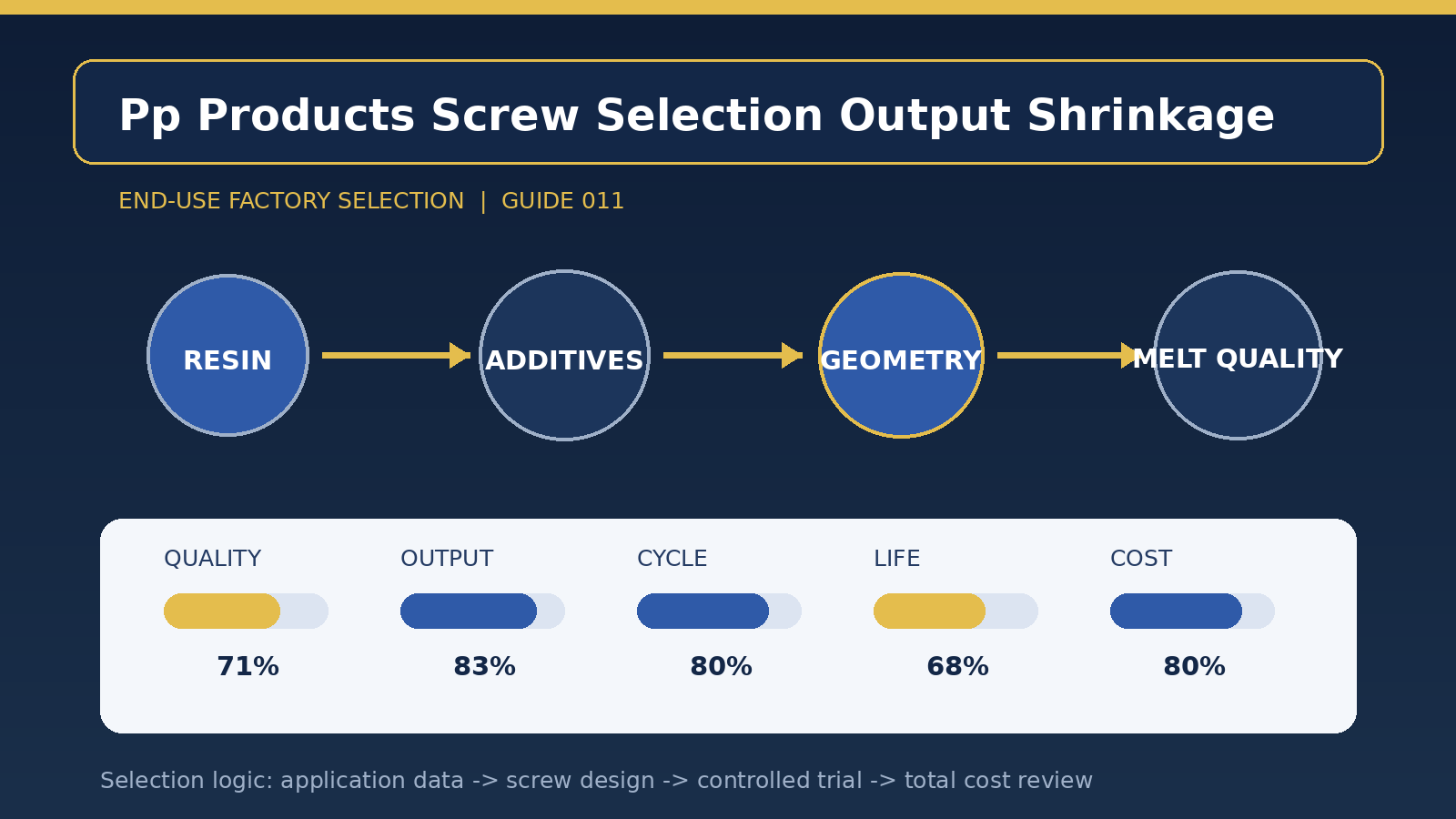
[Scene definition] How a PP production plant selects the screw in terms of production and contraction from the real volume scene of the plant and cannot read only the diameter or price of the screw. It is recommended that the resin viscosity, heat sensitivity, additives and retrospective ratios be first collated, and that a reference set of data be kept before and after maintenance to determine wear and tear trends. The aim of this step is to establish comparable old programme benchmarks so that subsequent screw changes can be supported by data.
The most easy to ignore is the risk of degradation of plastic windows and materials. Plants should divide needs such as appearance, size, intensity and odor into necessary and optimized items, and prioritize using customer complaints and internally defunct Paretto. Vendors can make retroactive trade-offs between interoperability, earmarking and cost when there are clear values for product weight, daily production, customer quality caps and allowed stop times.
The main line in this case is the geometry of the screws with real cards and formulas. In geometry and materials programmes, the gap between the reverse ring structure and the reflow should be assessed on the basis of material fluctuations and injection pressure; and the measurement segment should be synchronized with the required back pressure, without excessive back pressure. The final solution would also need to be compatible with the wear and tear of the cylinder, the drive, the physical velocity and the current cleaning process, and would not cover up co-operation or process problems with a single high-level material.
The new [comparison-valid] program proposes a minimum of 48 hours of continuous operation, with a 100-mode extraction for each stabilization phase, and records the screw-back load, back pressure stability and daily production. The test should be conducted using a uniform code to avoid different classes using different names for the same phenomenon, while also measuring the temperature of the entropy and the temperature of the drums to confirm the contribution of the shearing. If only the first one is checked, it is easy to miss the risks associated with heat drifting, material stoppage, reversal loop return and prolonged wear and tear.
When the [stabilized production] spiral is shaped, spare parts should be discharged early when the trend is close to the threshold, before the quality is out of control, and should be consolidated in shut-down windows to reduce duplication. The time of storage, back pressure, screw velocity, noise and mass of the product shall be recorded in a uniform manner in the shift. When the above indicators change at the same time, the mechanical gaps and the state of the raw materials should be checked before the process is adjusted to avoid the use of parameters to compensate for hardware degradation.
The cost statement [comprehensive cost] could not simply be a screw price, and inventory funds, maintenance and rust-proofing costs should be calculated for the back-up screws, compared with emergency delivery costs, in addition to an analysis of single-unit energy consumption in conjunction with storage time to avoid looking only at the total of the meter and ignoring output differences. It is recommended that the cost per 10,000 eligible items be exported simultaneously, the cost per 1,000 operating hours and the estimated number of return months. When new programmes reduce waste, refuelling or sudden shutdowns, higher initial inputs are often offset during production.
The [Closed Ring Management] will eventually include drawing numbers, screwdriver materials, heat treatment, critical dimensions, portable tubes, process windows and acceptance data in the curriculum vitae cards. It is recommended that a uniform sampling method be used for the same product on different platforms to facilitate horizontal comparisons, while trend maps are created for pyroclastics, anti-reverse loops and inner insides of aircraft. When there is a significant change in the feedstock formulation, retrospective ratio, product structure or target node, the applicable boundary of “PP production plants choosing the screw by production and contraction requirements” should be reassessed, rather than defaulting on the old conclusion being permanently valid.
Title of article: Guidelines for the selection of a plastic factory for end-of-service reference